What is RFID Security Testing?
Radio Frequency Identification (RFID) is the wireless technology behind most physical access control systems in the world — office building entry cards, hotel room keys, transit passes, and contactless payment cards. For security professionals, RFID is a critical attack surface that’s frequently overlooked. Billions of RFID-enabled access cards are in active use, and many operate on protocols with well-documented vulnerabilities. Cloning an employee’s access card from a few centimeters away — without them noticing — is a demonstrated, real-world technique used by red teams in physical penetration tests.
Is This Right for You?
This is for you if...
- You conduct physical penetration tests and need to assess access control systems
- You’re a security researcher studying RFID protocol vulnerabilities
- You want to understand how access cards can be cloned and how to defend against it
- You’ve outgrown what Flipper Zero’s RFID module can do and need deeper protocol analysis
- You’re building a professional hardware security lab
This is NOT for you if...
- You need a quick field cloner for simple use cases — iCopy-X is faster than Proxmark 3 for that
- You’re brand new to security — RFID tools require understanding of the protocols you’re testing
- You’re not authorized to test the systems you’re targeting — RFID cloning on unauthorized systems is illegal
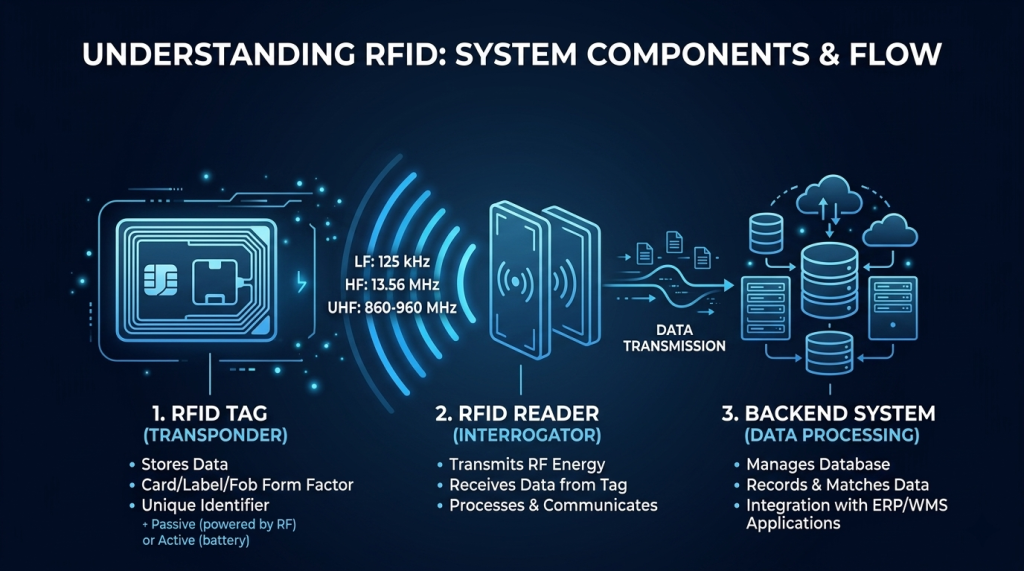
RFID Frequencies — What You're Working With
Tool Breakdown
Proxmark 3 RDV4 — The Professional Standard
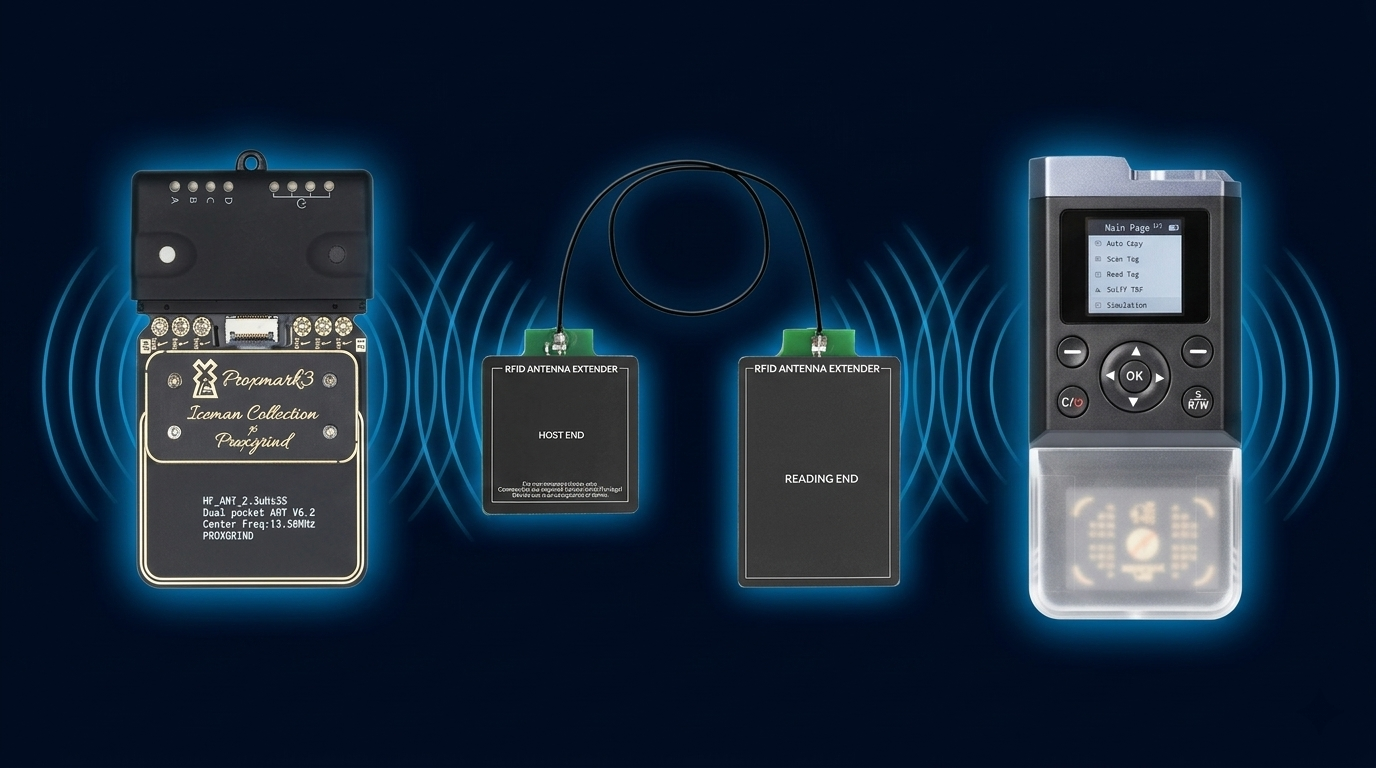
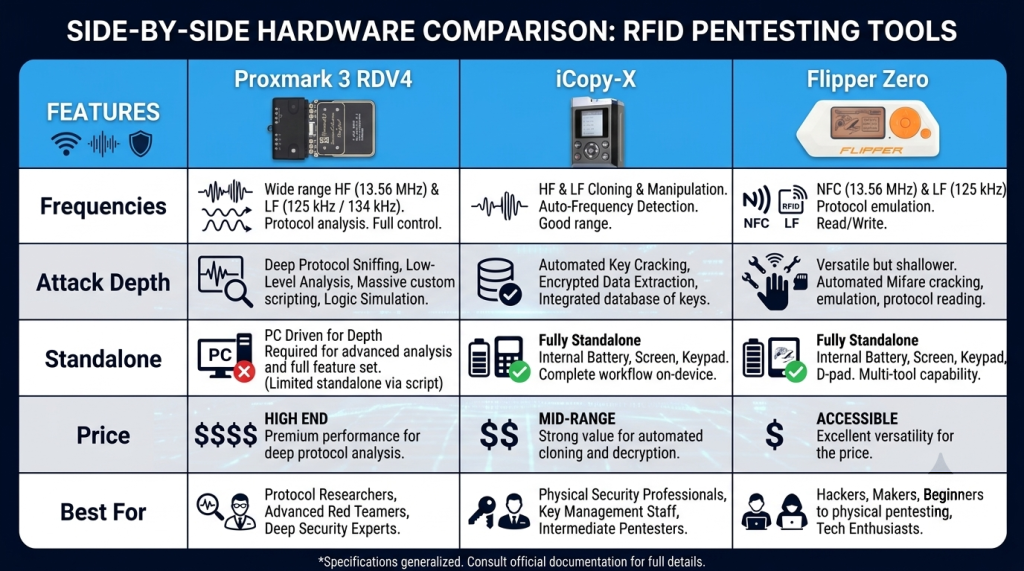
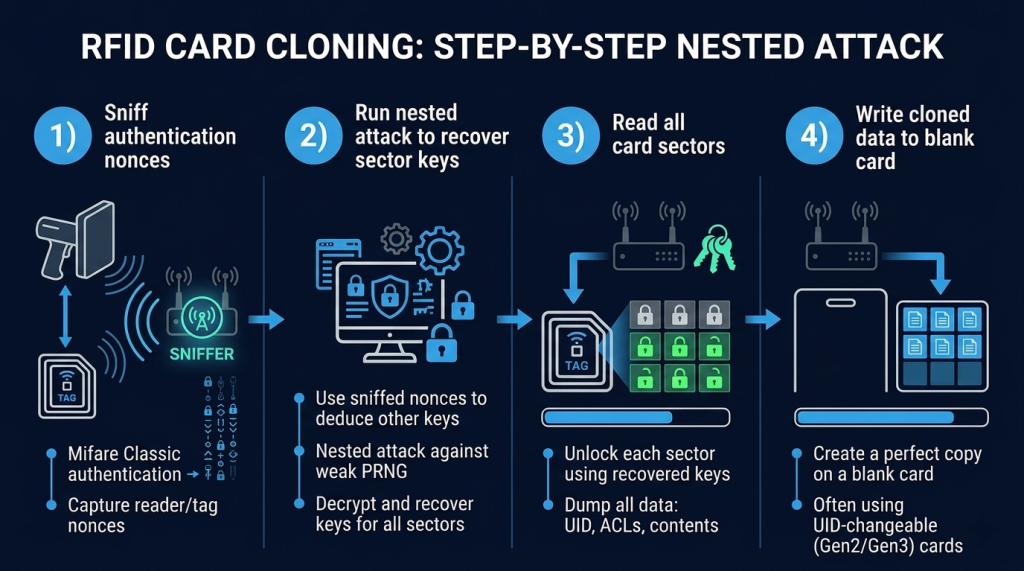
The Proxmark 3 is the most powerful and widely-used RFID research tool available. It can read, write, simulate, and sniff both LF and HF RFID protocols. The RDV4 ships with standalone mode, Bluetooth capability, and a modular antenna system. It runs the Iceman firmware — the actively-maintained community fork that supports the most current attacks including MIFARE Classic cryptanalysis, nested attacks, and hardnested attacks against locked cards.
iCopy-X — The Field Cloner
The iCopy-X is purpose-built for one thing: reading and cloning RFID cards fast in the field. It has a built-in display, rechargeable battery, and requires no laptop or companion app. For physical penetration testers who need to clone a badge quickly during an on-site assessment, iCopy-X is faster than Proxmark 3 in the field.
Flipper Zero — The Generalist
Flipper Zero handles basic 125kHz and 13.56MHz RFID/NFC tasks well. It’s the right starting point for RFID experimentation. For serious penetration testing, Proxmark 3 is the professional standard and iCopy-X is faster for field cloning.
How Security Professionals Use RFID Tools
Physical Penetration Testing — Badge Cloning
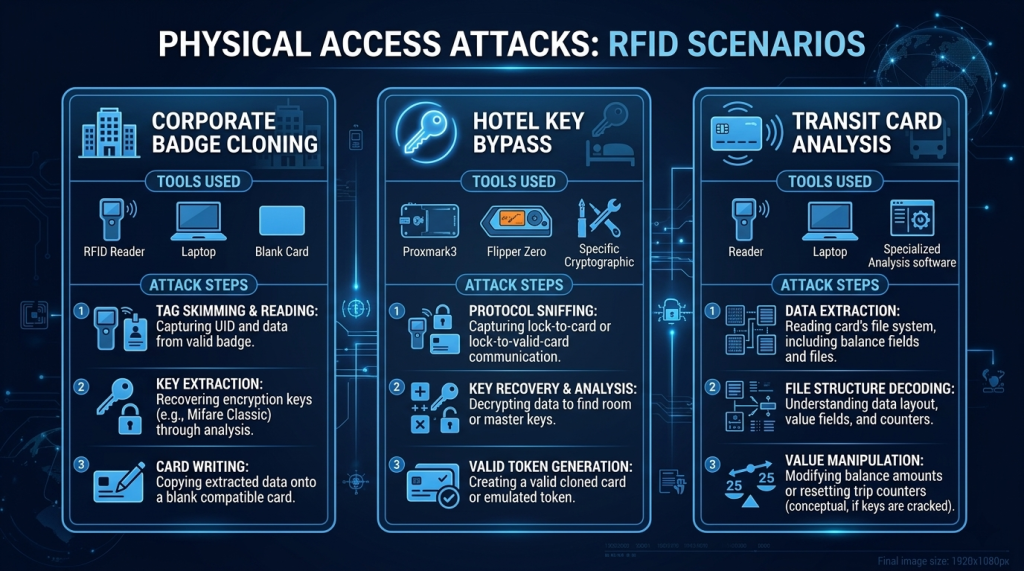
During a physical red team engagement, a tester may walk past a reception desk with a concealed Proxmark 3 or iCopy-X within range of an employee’s access card, clone the card’s credential silently, and use it to bypass physical access controls. The employee never notices.
- Test whether HID Prox or EM4100 cards in use are clonable — they almost always are
- Assess whether anti-cloning measures like challenge-response are implemented
- Demonstrate risk to executive stakeholders in a way that numbers alone don’t convey
MIFARE Classic Cryptanalysis
MIFARE Classic is the most widely deployed contactless smart card worldwide — used in transit systems, hotels, parking, and corporate access control. Despite known vulnerabilities in its CRYPTO1 cipher since 2008, it remains in active global deployment. Proxmark 3 with Iceman firmware can recover MIFARE Classic keys using nested attacks, giving full read/write access.
Where to Get RFID Tools
── SecVerse Marketplace — RFID Security Tools ──
Recommended Resources
- Proxmark — official Proxmark hardware source
- Iceman — Iceman firmware repository, the definitive Proxmark resource
- Proxmark3 Wiki — comprehensive protocol guides, attack tutorials, hardware documentation
- iCopy-x — official iCopy-X product page and firmware downloads
How to Get Started
- Buy your own test cards first. Get a pack of EM4100 125kHz cards and MIFARE Classic 1K cards — cheap on AliExpress or Amazon. Practice every read, write, emulate, and clone operation on cards you own before ever approaching a real access control system.
- Install Iceman firmware on your Proxmark 3. The stock firmware is outdated. Iceman firmware is actively maintained, better documented, and supports more attacks. Installation takes 10 minutes and is fully documented on the RRG GitHub.
- Build your methodology before your first engagement. Know which card type you’re targeting before you arrive. Identify frequency, manufacturer, and card model. Each has different tooling and approaches. Showing up prepared separates professionals from hobbyists.
📌 Note: The information on this page — including certification details, exam codes, pricing, and salary ranges — is regularly reviewed and updated to reflect the latest data from official sources. Always verify current details directly with the relevant certification body or platform before making any decisions.
Community & Support