Fortinet

FortiGate, FortiSIEM, FortiAnalyzer, FortiManager — One Unified Security Platform
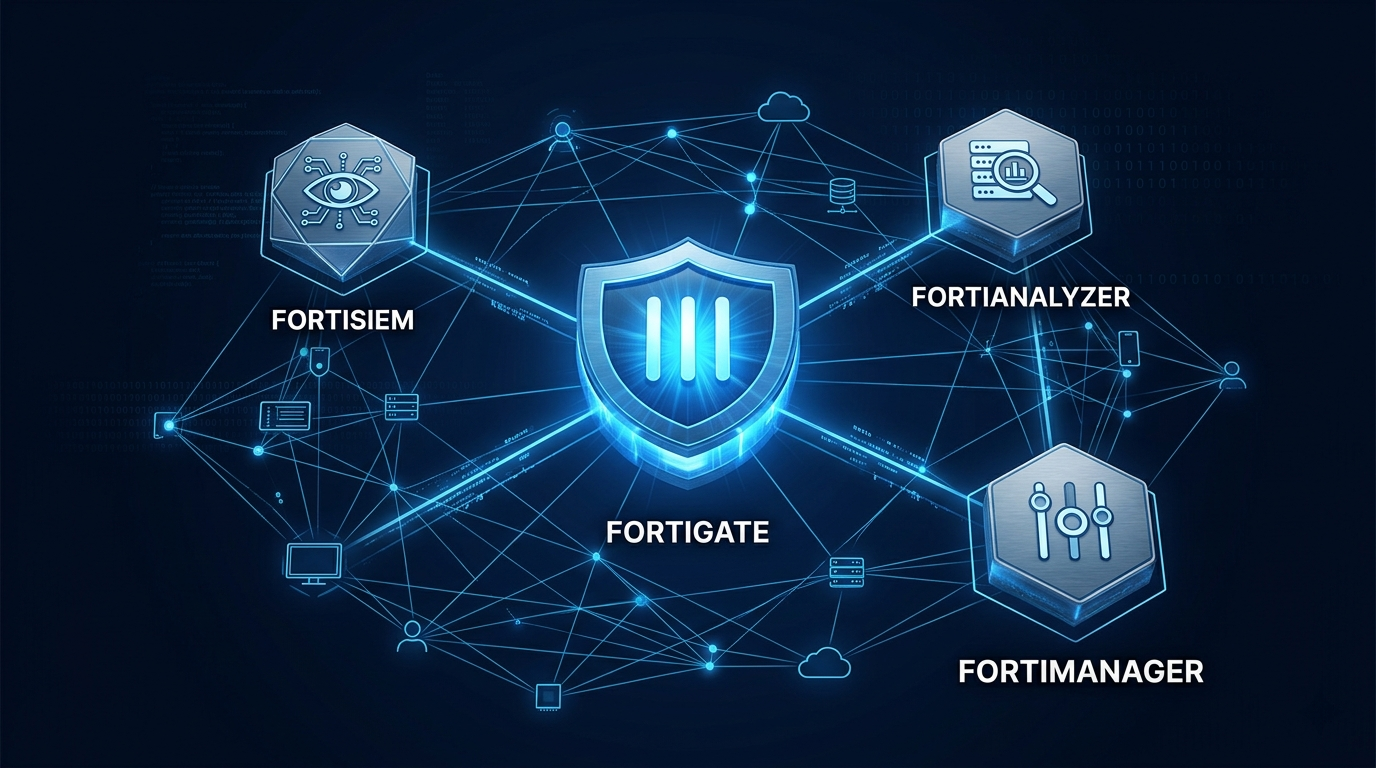
Fortinet Security Fabric Ecosystem

What is Fortinet?

Fortinet is one of the world’s largest cybersecurity vendors, best known for FortiGate — the world’s most deployed next-generation firewall. Their Security Fabric platform integrates firewalls, SD-WAN, endpoint protection, SIEM, and SOAR into a unified architecture. The NSE (Network Security Expert) certification program covers 8 levels from security awareness to expert-level engineering — and most of it is free.

Is This Right for You?

This is for you if...

  • You’re targeting network security or firewall engineering roles in enterprise environments
  • You work with or expect to work with Fortinet products (FortiGate, FortiSIEM, FortiAnalyzer)
  • You want free certification training — Fortinet offers NSE 1–7 training at no cost
  • You want a certification that complements Cisco or CompTIA credentials with vendor depth
  • You’re targeting MSSP roles — Fortinet is dominant in the managed security services space

This is NOT for you if...

  • You want vendor-neutral credentials — pair Fortinet with CompTIA, not replace it
  • You’re focused on offensive security — Fortinet is a defensive/infrastructure track

Certification Roadmap

CompTIA structures its certs into clear tiers. Here’s the full path from zero to advanced:

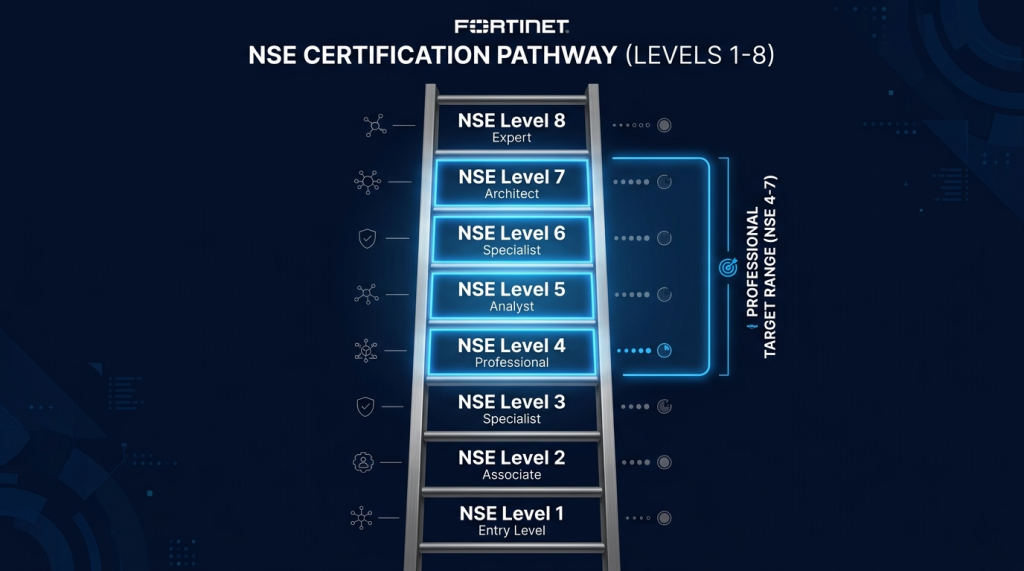
NSE 1–3 (Free Foundation) → NSE 4 (Professional) → NSE 5–6 (Specialist) → NSE 7–8 (Expert)
Fortinet NSE Certification Ladder

Phase 1 — Foundation (NSE 1–3, Free)

Level Focus Cost Format
NSE 1 — Information Security Awareness
Threat landscape, security mindset
Free
Online, self-paced
NSE 2 — The Evolution of Cybersecurity
Security technologies overview
Free
Online, self-paced
NSE 3 — Fortinet Security Fabric
Fortinet product ecosystem intro
Free
Online, self-paced

Phase 2 — Associate Level (NSE 4)

NSE 4 — FortiGate Security is the core professional certification. It validates the ability to configure and manage a FortiGate firewall including policies, SSL inspection, IPS, web filtering, VPNs, and SD-WAN.

Certification Exam Code Focus Exam Length Passing Score
NSE 4 — FortiGate Security
NSE4_FGT-7.4
FortiGate configuration, policies, security profiles
60 questions / 90 min
72%
NSE 4 — FortiGate Infrastructure
NSE4_FGT-7.4
Routing, SD-WAN, HA, VDOMs
60 questions / 90 min
72%

Phase 3 — Professional Level (NSE 5–6)

Certification Focus
NSE 5 — FortiSIEM
Fortinet SIEM — event correlation, dashboards, reporting
NSE 5 — FortiManager
Centralized FortiGate management across enterprise environments
NSE 5 — FortiAnalyzer
Log management, analytics, and compliance reporting
NSE 6 — FortiAuthenticator
Identity and access management integration
NSE 6 — FortiMail
Email security and anti-spam
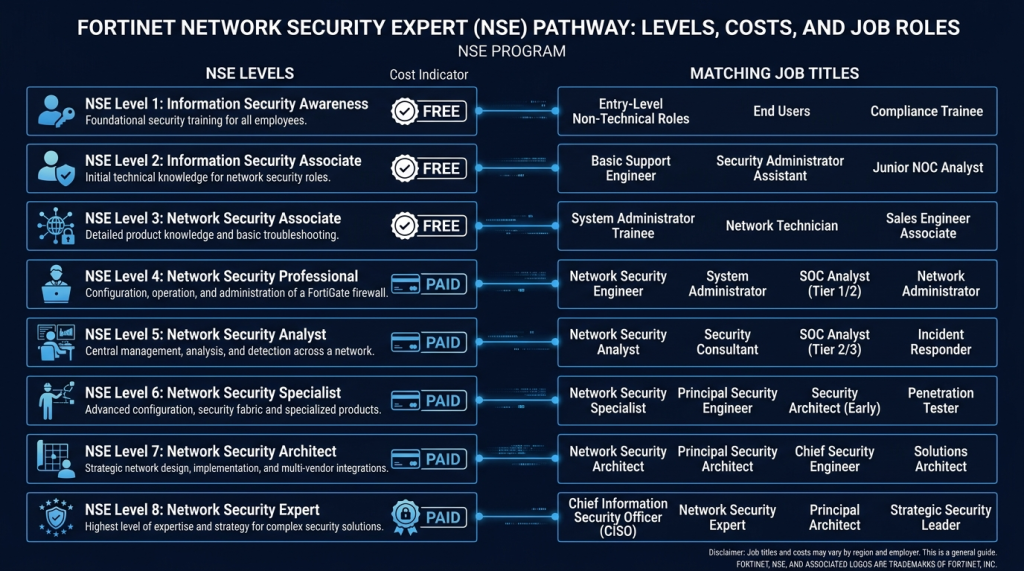
From Firewall Engineer at NSE 4 to Senior Security Architect at NSE 7–8
Fortinet NSE Career Map

Phase 4 — Expert Level (NSE 7–8)

Certification Format Focus
NSE 7 — Enterprise Firewall
Written exam
Advanced FortiGate, SD-WAN, and security fabric design
NSE 8
Written + practical lab
Expert-level Fortinet security architecture

Career Opportunities

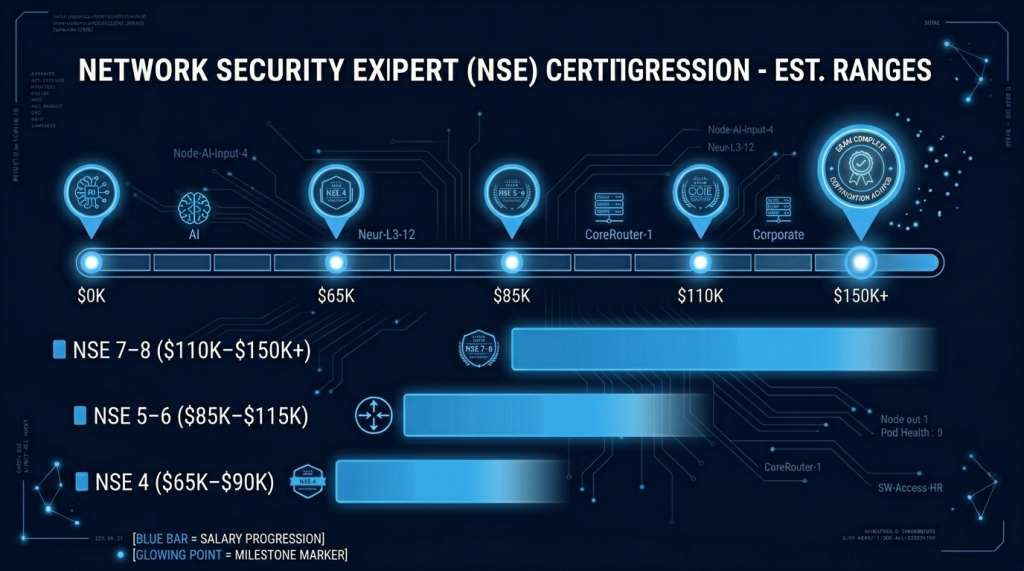
Certification Target Job Titles Average Salary (US)
NSE 4
Firewall Engineer, Network Security Analyst, MSSP Technician
$65,000 – $90,000
NSE 5–6
Network Security Engineer, FortiSIEM Administrator
$85,000 – $115,000
NSE 7–8
Senior Security Engineer, Security Architect
$110,000 – $150,000+
Average US Salaries by Fortinet NSE Level — NSE 4 Through NSE 7–8
Fortinet Salary Comparison Chart

Recommended Resources

Official Study Guides

Where to Practice

── Hands-On Practice Platforms ──

  • Cisco Packet Tracer — networking fundamentals before FortiGate specialization 
  • GNS3 — advanced topology simulation with FortiGate VM integration 
  • Hack The Box — network security machines for firewall concept reinforcement

How to Set Up Your FortiGate Practice Lab

Fortinet provides a free evaluation VM of FortiOS — the actual FortiGate operating system — that runs in VirtualBox, VMware, or GNS3. This is not a simulator. It is real FortiGate firmware running in a virtual environment, identical in behavior to physical hardware. For NSE 4, NSE 5, and NSE 7 candidates, a FortiGate VM lab is the most effective way to build hands-on configuration skills before the exam.

What You Need

  • FortiGate VM evaluation image (free 30-day eval license from fortinet.com/demo/fortigate — renewable, full feature access)
  • VirtualBox (free) or VMware Workstation to host the FortiGate VM
  • Minimum 2GB RAM and 2 vCPUs allocated to the FortiGate VM for stable operation
  • At least two virtual network adapters — one for management access, one for LAN/WAN interface simulation

What You Can Practice

  • Firewall policy configuration — create, order, and test security policies exactly as NSE 4 tests them
  • NAT configuration — source NAT, destination NAT, and VIP (Virtual IP) for inbound traffic
  • IPSec and SSL VPN configuration — site-to-site and remote access VPN setups tested in NSE 4 and NSE 5
  • Security profiles — antivirus, web filtering, application control, IPS — the core NSE 4 exam content
  • SD-WAN configuration — traffic shaping, performance SLA, and failover logic tested in NSE 5 and NSE 7
  • HA (High Availability) cluster configuration — active-passive and active-active FortiGate pairs (NSE 5 and above)

FortiGate VM in GNS3

The GNS3 community maintains an official FortiGate VM appliance template. This lets you run a FortiGate node inside a GNS3 topology alongside Cisco routers, MikroTik switches, and Huawei devices simultaneously. For NSE 7 and advanced security fabric practice — where FortiGate needs to communicate with other network devices — GNS3 integration is the most realistic lab environment available without physical hardware.

FortiGate VM eval license: fortinet.com/demo/fortigate | GNS3 appliance template: https://www.gns3.com/

How to Get Started

  1. Complete NSE 1–3 this week. They’re free, online, take a few hours total. They give you the Fortinet vocabulary and baseline understanding. Do it now.
  2. Study for NSE 4 with official materials. Download the FortiGate Security study guide. Lab every topic you study — theory without hands-on doesn’t pass NSE 4.
  3. Build a FortiGate home lab. Get a free FortiOS VM evaluation license. Run it in VMware or GNS3. Configure policies, test IPS, set up a site-to-site VPN. You learn FortiGate by touching FortiGate.

📌 Note: The information on this page — including certification details, exam codes, pricing, and salary ranges — is regularly reviewed and updated to reflect the latest data from official sources. Always verify current details directly with the relevant certification body or platform before making any decisions.

Community & Support

Related Articles

The 6 Learning Paths Every Cybersecurity Beginner Should Know

Affiliate Disclaimer: Some links in this article are affiliate links. This means if you click a link and make a purchase, SecVerse may earn a small commission — at no extra cost to you. We only recommend tools we genuinely believe in and that we consider useful for your cybersecurity learning journey. Our editorial opinions are never influenced by affiliate relationships. Introduction: **In our first guide**, we covered how to start learning cybersecurity without feeling overwhelmed. If you haven’t read it yet, start there. Now, let’s talk about which path to take once you’re ready. When I decided to get into cybersecurity 20 years ago after I graduated from school of engineering as computer engineer, I had no idea which path to take. I bought a CEH course first. Then I bought a Security+ book. Then I tried to learn networking. I was all over the place. Don’t be me.
Read More »

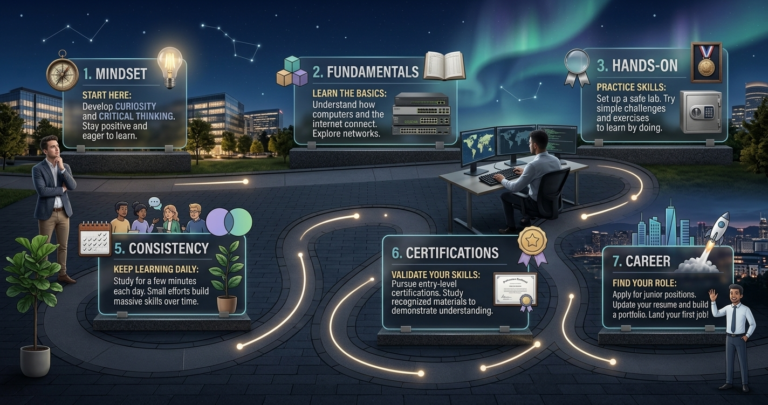
How to Start Learning Cybersecurity Without Feeling Overwhelmed

Affiliate Disclaimer: Some links in this article are affiliate links. This means if you click a link and make a purchase, SecVerse may earn a small commission — at no extra cost to you. We only recommend tools we genuinely believe in and that we consider useful for your cybersecurity learning journey. Our editorial opinions are never influenced by affiliate relationships. Introduction: The Overwhelm is Real (But Avoidable) Let’s be honest with ourselves to avoid the shock and be realistic. Cyber security is huge, branching, and massive field. When I decided to get and start in this field 20 years ago. I made every mistake imaginable: Bought expensive courses I never finished. Tried to learn everything at once – pentesting, malware analysis, cloud security, forensics. All in short time. Got trapped in “tutorial”- watching videos for hours but never actually doing anything because of not practicing them and being confused.

Read More »