CISCO

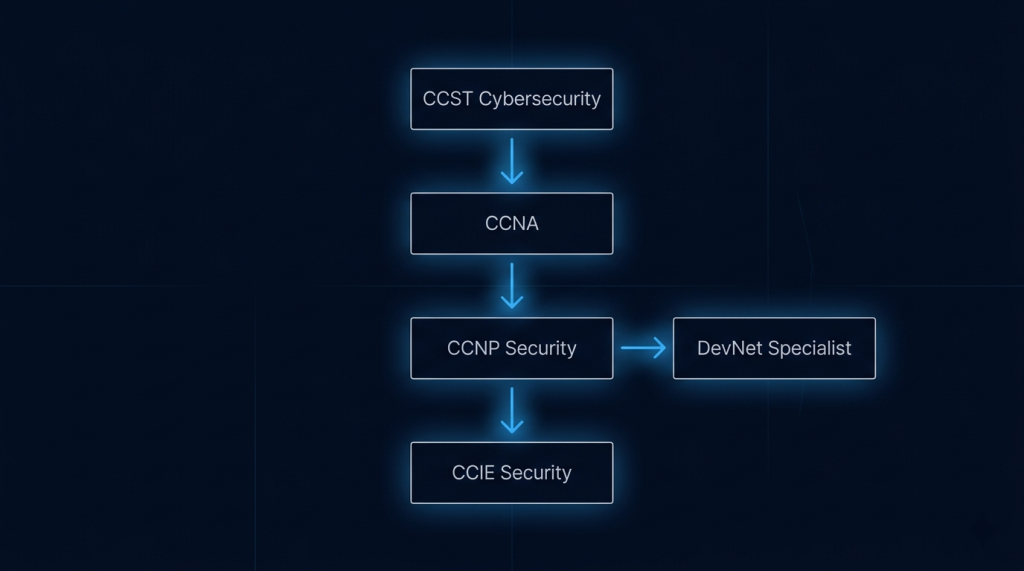
CCST → CCNA → CCNP Security → CCIE Security: The Path to Network Security Mastery
Cisco Career Certification Roadmap

What is Cisco?

Cisco Systems is the foundational infrastructure of the global internet. As Cisco states:

For more than 35 years, Cisco has been the worldwide leader in networking, transforming how people connect, communicate, and collaborate.

On security specifically:

In today’s threat landscape, security can’t be an add-on — it must be built into the network from the ground up. Cisco certifications validate that professionals can design, implement, and operate secure network infrastructures.”

Is This Right for You?

This is for you if...

  • You want to specialize in network security at the enterprise or service provider level
  • You’re targeting DoD 8570 roles — CCNA Security and CCNP Security both qualify
  • You want deep, vendor-specific expertise that commands premium salaries
  • You’re working toward Network Security Engineer, Security Architect, or NOC/SOC lead roles
  • You already have a networking foundation and want to move into security

This is NOT for you if...

  • You want vendor-neutral fundamentals first — start with CompTIA instead
  • You’re focused purely on offensive security — OffSec or EC-Council tracks serve that better
  • You’re not ready to invest significant time — CCNP and CCIE require serious commitment

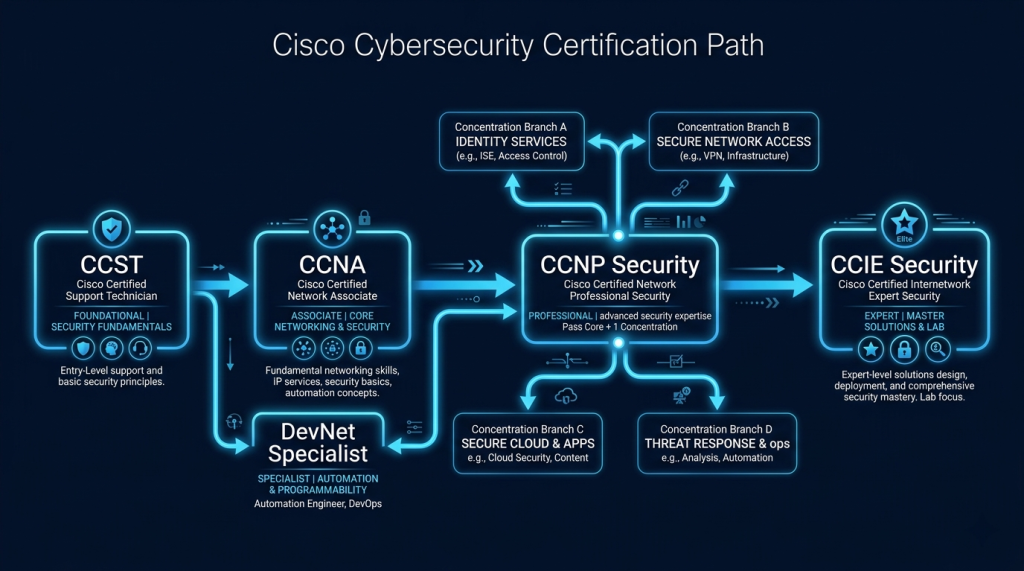
Certification Roadmap

Four Phases of Cisco Network Security Certification: Entry to Expert
Cisco Certification Roadmap Diagram

Phase 1 — Entry Level (0–6 Months)

Cisco launched the CCST as their true entry point:

The CCST certifications validate the skills required for entry-level support roles in networking and cybersecurity — the ideal starting point for new IT professionals.

Certification Exam Code Focus Passing Score
CCST Networking
100-150
Networking fundamentals
750/1000
CCST Cybersecurity
100-160
Security operations baseline
750/1000

Cisco Systems is the foundational infrastructure of the global internet. As Cisco states:

For more than 35 years, Cisco has been the worldwide leader in networking, transforming how people connect, communicate, and collaborate.

On security specifically:

In today’s threat landscape, security can’t be an add-on — it must be built into the network from the ground up. Cisco certifications validate that professionals can design, implement, and operate secure network infrastructures.

Phase 2 — Associate Level (3–12 Months)

CCNA is the most sought-after Cisco certification globally:

CCNA validates the ability to install, configure, operate, and troubleshoot medium-size routed and switched networks. It’s the essential foundation for all Cisco career certifications.

Certification Exam Code Focus Exam Length Passing Score
CCNA
200-301
Networking, security fundamentals, automation
120 questions / 120 min
825/1000

Phase 3 — Professional Level (12–30 Months)

CCNP Security requires one core exam plus one concentration exam:

CCNP Security validates the skills required to design, implement, and operate core security technologies including infrastructure, perimeter, content security, secure access, and visibility.

Certification Code Focus Duration Passing Score
Core (required)
SCOR 350-701
Implementing and Operating Cisco Security Core Technologies
90–110 questions/90 min
825/1000
Concentration: Firepower
SNCF 300-710
Securing Networks with Cisco Firepower
90–110 questions/90 min
825/1000
Concentration: ISE
SISE 300-715
Implementing and Configuring Cisco Identity Services Engine
90–110 questions/90 min
825/1000
Concentration: VPN
SVPN 300-730
Implementing Secure Solutions with Virtual Private Networks
90–110 questions/90 min
825/1000
Concentration: Automation
SAUI 300-735
Automating and Programming Cisco Security Solutions
90–110 questions/90 min
825/1000

Phase 4 — Expert Level (30–48+ Months)

CCIE Security is the pinnacle:

CCIE Security certifies expert-level knowledge and skills required to design, implement, and manage comprehensive security solutions. Candidates should have 5–7 years of experience before attempting.

Certification Format Focus Duration Passing Score
CCIE Security — Written
400-251
Security architecture and theory
120 minutes/90 min
800/1000
CCIE Security — Lab
Practical
End-to-end security implementation
8 hours/
Pass/Fail (no numeric score — Cisco uses a holistic assessment)
From NOC Analyst to Security Architect — Cisco Certifications and the Roles They Unlock
Cisco Career Path Visual

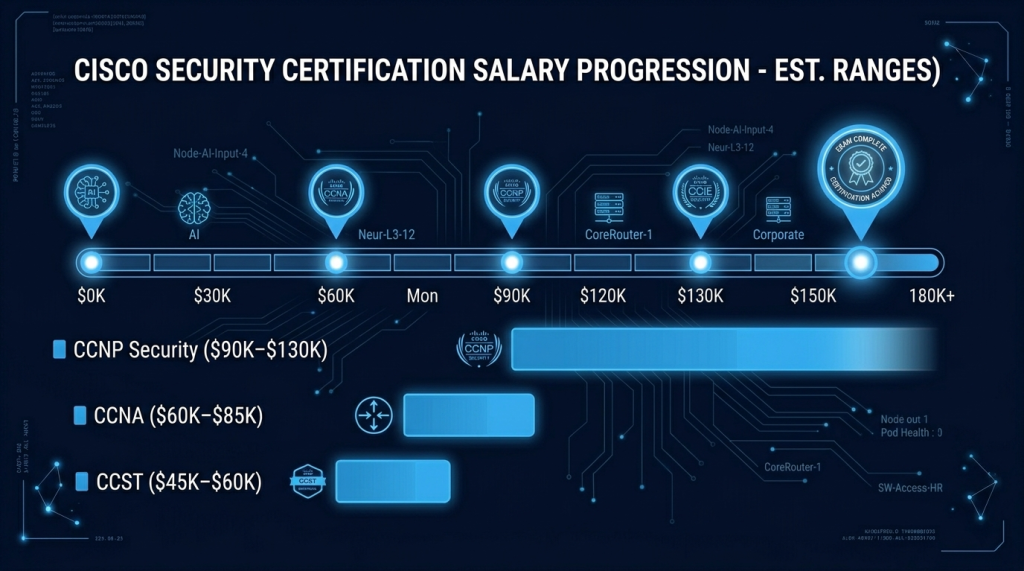
Career Opportunities

Certification Target Job Titles Average Salary (US)
CCST
IT Support Technician, Junior NOC Analyst
$45,000 – $60,000
CCNA
Network Administrator, Junior Network Engineer
$60,000 – $85,000
CCNP Security
Network Security Engineer, Firewall Engineer
$90,000 – $130,000
CCIE Security
Senior Security Architect, Principal Engineer
$130,000 – $180,000+
Average US Salaries by Cisco Certification Level — CCST Through CCIE Security
Cisco Salary Comparison Chart

Recommended Resources

Official Study Guides

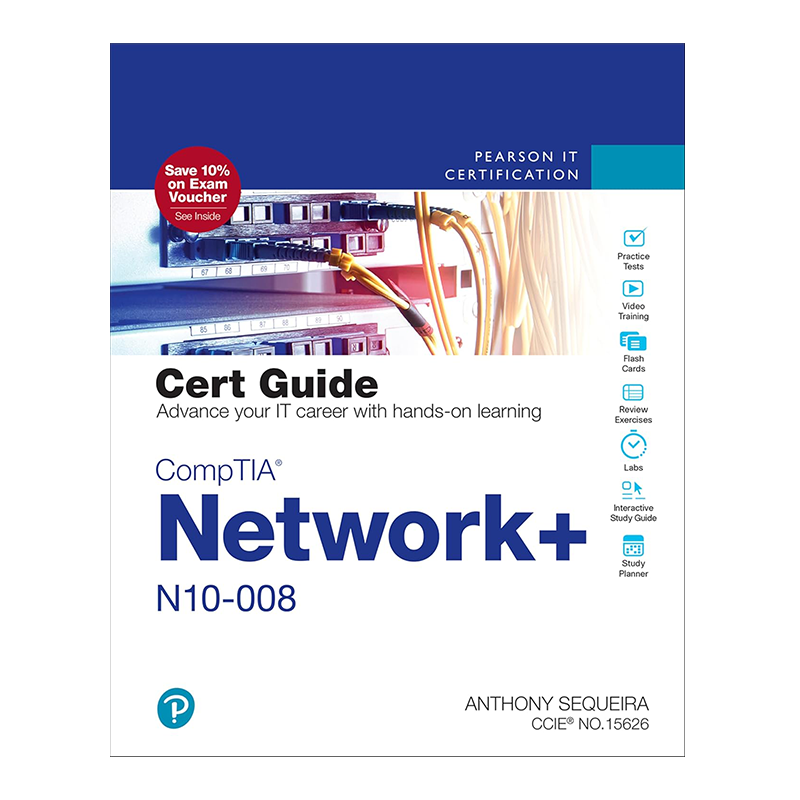
Cisco Press is the only publisher approved directly by Cisco:

Cisco Press Official Cert Guides are developed in close collaboration with the Cisco certification team and provide comprehensive coverage of exam objectives.

Where to Practice

── Hands-On Practice Platforms ──

  • Cisco Packet Tracer — official free network simulation tool 
  • GNS3 — advanced multi-vendor network simulation for CCNP/CCIE prep 
  • Hack The Box — network-focused machines for security concepts

How to Get Started

  1. Start with Packet Tracer. Download it free from Cisco NetAcad. Build your first network topology on day one. Hands-on from the beginning — not after months of reading.
  2. Get your CCNA first. Even if your goal is CCIE, CCNA is the foundation. Wendell Odom’s Official Cert Guide plus David Bombal’s labs. Give yourself 3–6 months.
  3. Pick your CCNP concentration early. Know your direction before you start — Firepower for network security, ISE for access control, SVPN for secure connectivity.

📌 Note: The information on this page — including certification details, exam codes, pricing, and salary ranges — is regularly reviewed and updated to reflect the latest data from official sources. Always verify current details directly with the relevant certification body or platform before making any decisions.

Community & Support

Related Articles

The 6 Learning Paths Every Cybersecurity Beginner Should Know

Affiliate Disclaimer: Some links in this article are affiliate links. This means if you click a link and make a purchase, SecVerse may earn a small commission — at no extra cost to you. We only recommend tools we genuinely believe in and that we consider useful for your cybersecurity learning journey. Our editorial opinions are never influenced by affiliate relationships. Introduction: **In our first guide**, we covered how to start learning cybersecurity without feeling overwhelmed. If you haven’t read it yet, start there. Now, let’s talk about which path to take once you’re ready. When I decided to get into cybersecurity 20 years ago after I graduated from school of engineering as computer engineer, I had no idea which path to take. I bought a CEH course first. Then I bought a Security+ book. Then I tried to learn networking. I was all over the place. Don’t be me.
Read More »

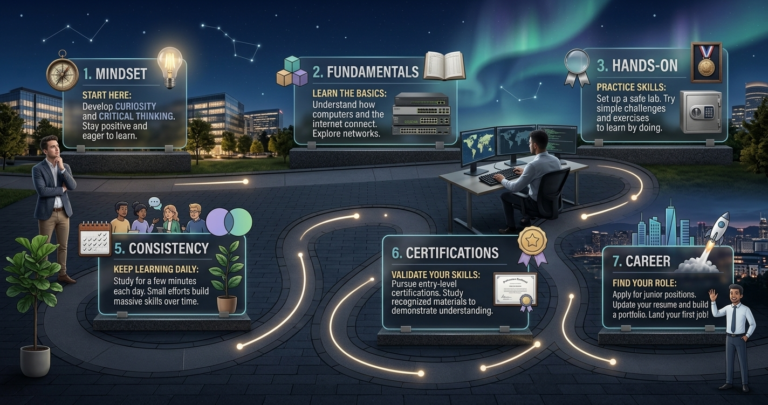
How to Start Learning Cybersecurity Without Feeling Overwhelmed

Affiliate Disclaimer: Some links in this article are affiliate links. This means if you click a link and make a purchase, SecVerse may earn a small commission — at no extra cost to you. We only recommend tools we genuinely believe in and that we consider useful for your cybersecurity learning journey. Our editorial opinions are never influenced by affiliate relationships. Introduction: The Overwhelm is Real (But Avoidable) Let’s be honest with ourselves to avoid the shock and be realistic. Cyber security is huge, branching, and massive field. When I decided to get and start in this field 20 years ago. I made every mistake imaginable: Bought expensive courses I never finished. Tried to learn everything at once – pentesting, malware analysis, cloud security, forensics. All in short time. Got trapped in “tutorial”- watching videos for hours but never actually doing anything because of not practicing them and being confused.
Read More »