
Huawei

Routers, Switches, and Security Systems Powering Telecom Networks Across Asia, Middle East, and Africa
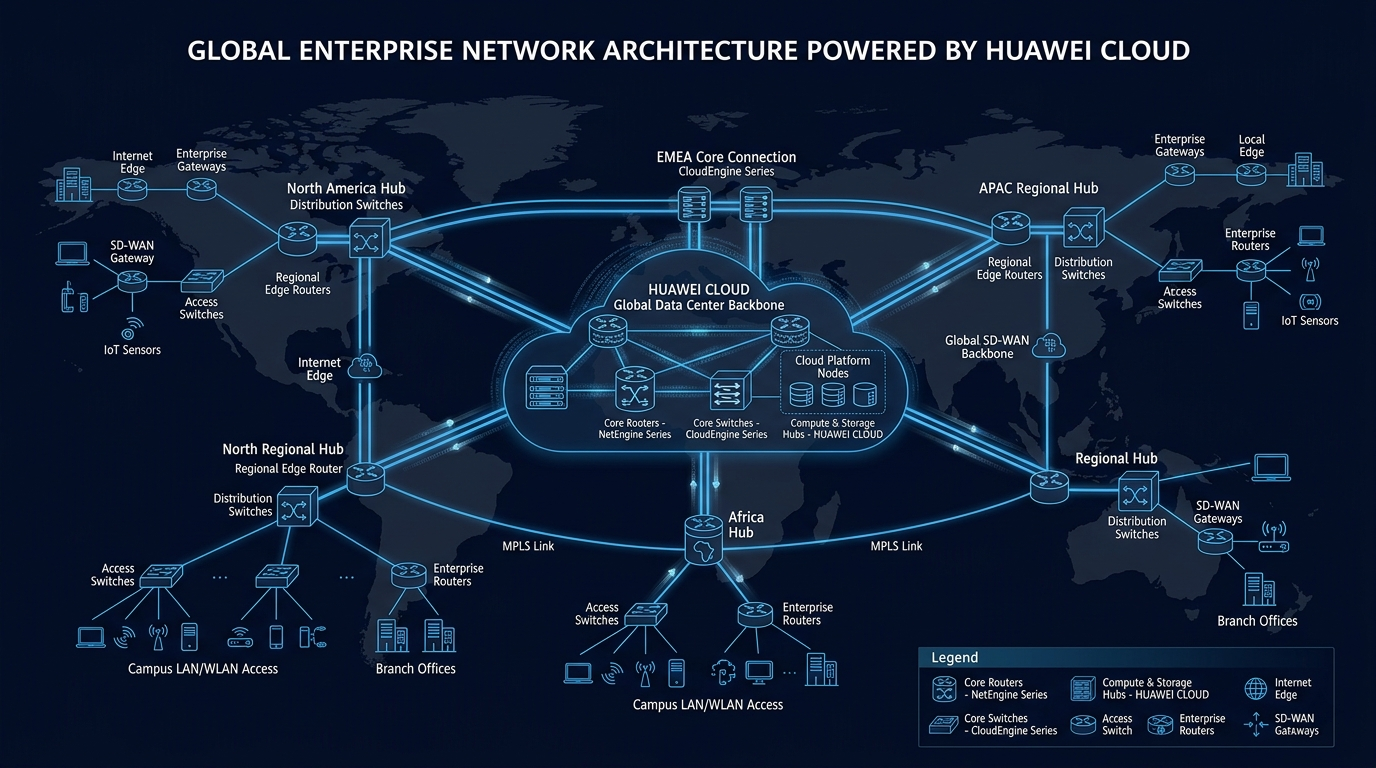
Huawei Global Network Infrastructure

What is Huawei ICT Certification?

Huawei is the world’s largest telecommunications equipment manufacturer and a dominant networking vendor across Asia, the Middle East, Africa, and Europe. Their HCIA / HCIP / HCIE certification hierarchy is the Huawei equivalent of Cisco’s CCNA / CCNP / CCIE — structured, rigorous, and highly valued in regions where Huawei infrastructure is the standard. If you’re targeting network security roles outside North America — particularly in China, Southeast Asia, the Middle East, or Africa — Huawei certifications carry the same weight Cisco does in the US.

Huawei’s HCIP and HCIE Security tracks cover the USG firewall series — Huawei’s enterprise next-generation firewall platform. Exam content includes firewall policy configuration, NAT, VPN deployment, and threat defense using real Huawei USG hardware and eNSP simulation software.

Is This Right for You?

This is for you if...

  • You’re targeting network security roles in regions where Huawei is the dominant vendor
  • You work in or want to work in telecommunications — Huawei powers many global carrier networks
  • You want to complement Cisco or CompTIA credentials with a second major vendor ecosystem
  • You want a more affordable certification alternative with comparable technical depth to CCNP

This is NOT for you if...

  • You’re exclusively targeting US government or DoD roles — Huawei equipment is restricted there
  • You want the broadest global employer recognition — Cisco leads in most Western markets
  • You’re new to networking — start with CompTIA Network+ or CCNA first

Certification Roadmap

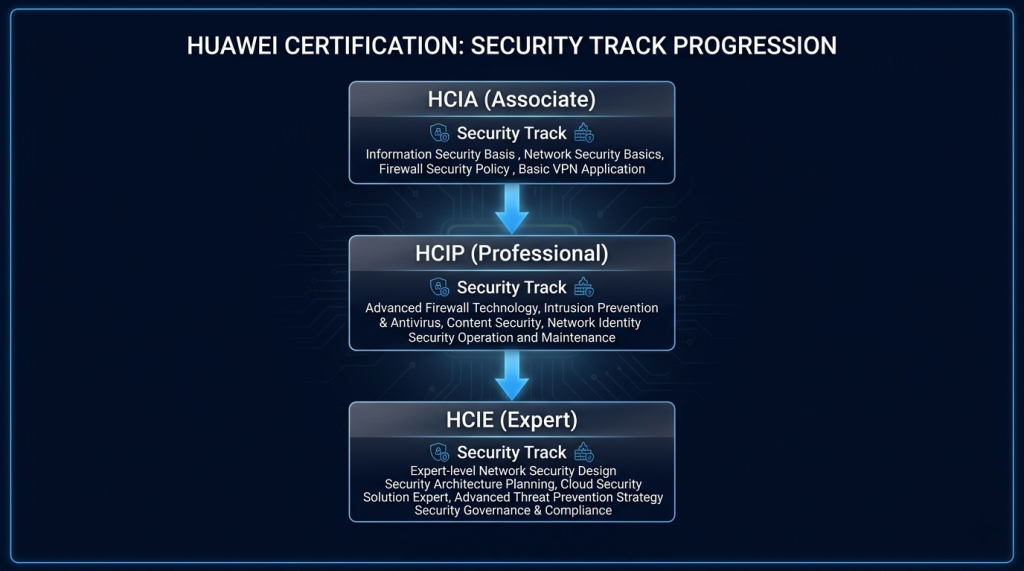
HCIA Associate → HCIP Professional → HCIE Expert: The Huawei Certification Hierarchy
Huawei-ICT-Certification-Roadmap

Phase 1 — Associate Level (HCIA)

Certification Exam Code Focus Exam Length Passing Score
HCIA-Security
H12-711
Firewall basics, VPN, IDS/IPS, security policy
60 questions / 90 min
600/1000
HCIA-Datacom
H12-811
Network fundamentals, routing, switching
60 questions / 90 min
600/1000

Phase 2 — Professional Level (HCIP)

Certification Exam Code Focus
HCIP-Security
H12-721/722/723
Advanced firewall, UTM, IPSec, PKI — three module exams
HCIP-Datacom
H12-821/831
Advanced routing, switching, network design

Phase 3 — Expert Level (HCIE)

Certification Format Focus
HCIE-Security
Written + 8-hour lab exam
Expert-level security architecture on Huawei platforms
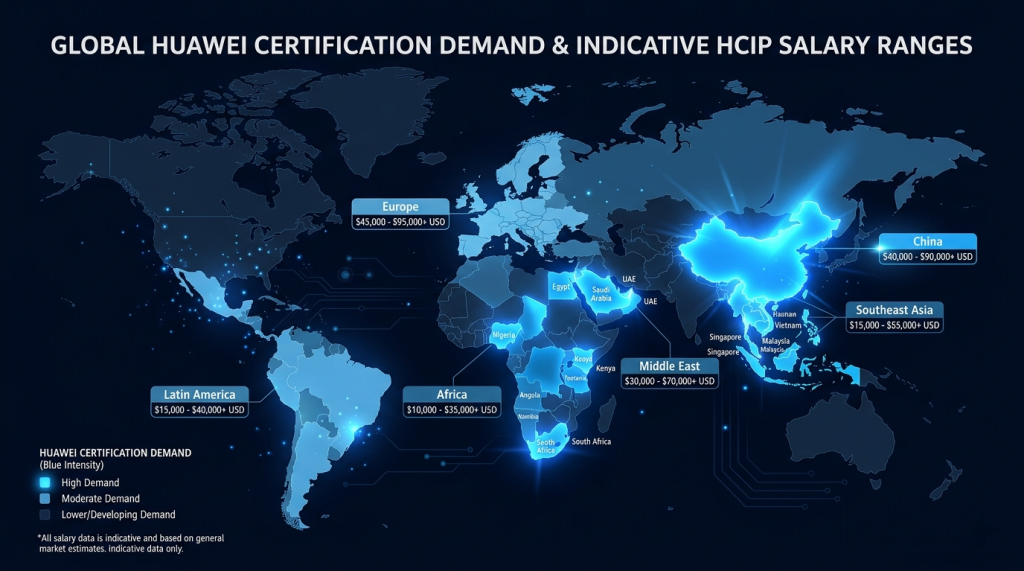
Where Huawei Certifications Carry the Most Weight — Global Market Overview
Huawei-Regional-Demand-Map

Career Opportunities

Certification Target Job Titles Regions of Strongest Demand
HCIA
Network Support Engineer, Junior Security Analyst
China, Middle East, Africa, SE Asia
HCIP
Network Security Engineer, Firewall Engineer
Global enterprise, telecom
HCIE
Senior Network Security Architect, Principal Engineer
Global — highest in Huawei-dominant regions
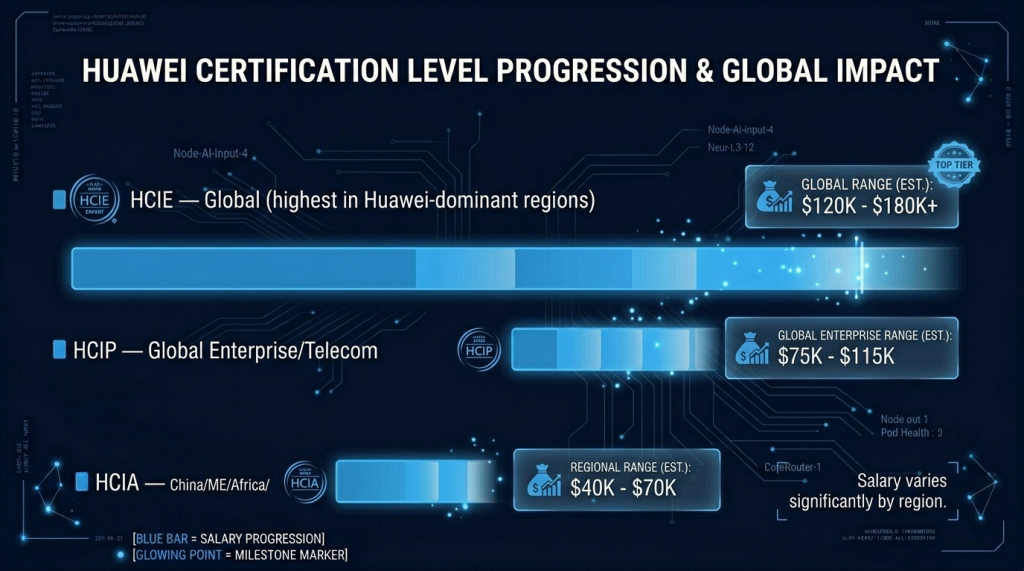
Salary Ranges by Huawei Certification Level — HCIA Through HCIE, Across Key Regions
Huawei Salary Comparison Chart

Recommended Resources

Official Study Guides

Where to Practice

── Hands-On Practice Platforms ──

  • GNS3 — advanced topology simulation supporting Huawei VRP images 
  • Cisco Packet Tracer — networking concept foundation before Huawei specialization 
  • Hack The Box — network security machines for practical skill building 

How to Get Started

  1. Install Huawei eNSP immediately. Free from Huawei’s support site. Runs virtual Huawei routers, switches, and firewalls. Build a simple network and ping across it before reading anything else.
  2. Start with HCIA-Datacom if you’re new to networking. HCIA-Security assumes networking knowledge. Datacom first, Security second.
  3. Use Huawei Learning for free HCIA prep. The HCIA courses on Huawei Learning are free and official. Complete the online courses, then supplement with eNSP labs.

📌 Note: The information on this page — including certification details, exam codes, pricing, and salary ranges — is regularly reviewed and updated to reflect the latest data from official sources. Always verify current details directly with the relevant certification body or platform before making any decisions.

Community & Support

Related Articles

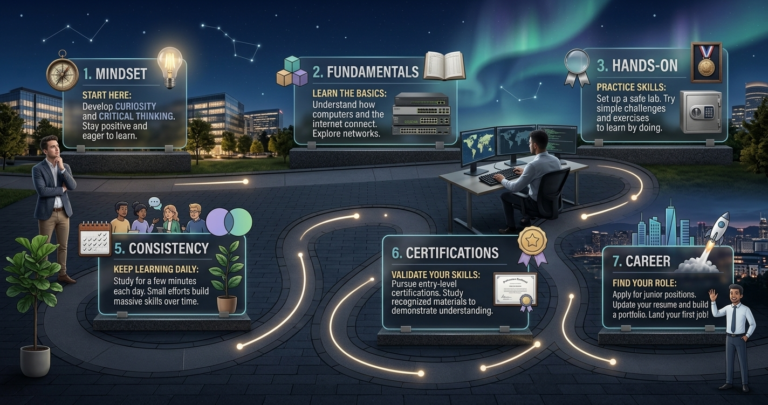
The 6 Learning Paths Every Cybersecurity Beginner Should Know

Affiliate Disclaimer: Some links in this article are affiliate links. This means if you click a link and make a purchase, SecVerse may earn a small commission — at no extra cost to you. We only recommend tools we genuinely believe in and that we consider useful for your cybersecurity learning journey. Our editorial opinions are never influenced by affiliate relationships. Introduction: **In our first guide**, we covered how to start learning cybersecurity without feeling overwhelmed. If you haven’t read it yet, start there. Now, let’s talk about which path to take once you’re ready. When I decided to get into cybersecurity 20 years ago after I graduated from school of engineering as computer engineer, I had no idea which path to take. I bought a CEH course first. Then I bought a Security+ book. Then I tried to learn networking. I was all over the place. Don’t be me.
Read More »

How to Start Learning Cybersecurity Without Feeling Overwhelmed

Affiliate Disclaimer: Some links in this article are affiliate links. This means if you click a link and make a purchase, SecVerse may earn a small commission — at no extra cost to you. We only recommend tools we genuinely believe in and that we consider useful for your cybersecurity learning journey. Our editorial opinions are never influenced by affiliate relationships. Introduction: The Overwhelm is Real (But Avoidable) Let’s be honest with ourselves to avoid the shock and be realistic. Cyber security is huge, branching, and massive field. When I decided to get and start in this field 20 years ago. I made every mistake imaginable: Bought expensive courses I never finished. Tried to learn everything at once – pentesting, malware analysis, cloud security, forensics. All in short time. Got trapped in “tutorial”- watching videos for hours but never actually doing anything because of not practicing them and being confused.

Read More »