What is Microsoft Security Certification?
Microsoft is the dominant enterprise technology vendor on the planet. Their operating systems, cloud platform, identity solutions, and productivity tools run the majority of the world’s organizations — from Fortune 500 companies to government agencies and military branches. Where Microsoft infrastructure goes, Microsoft security certifications follow.
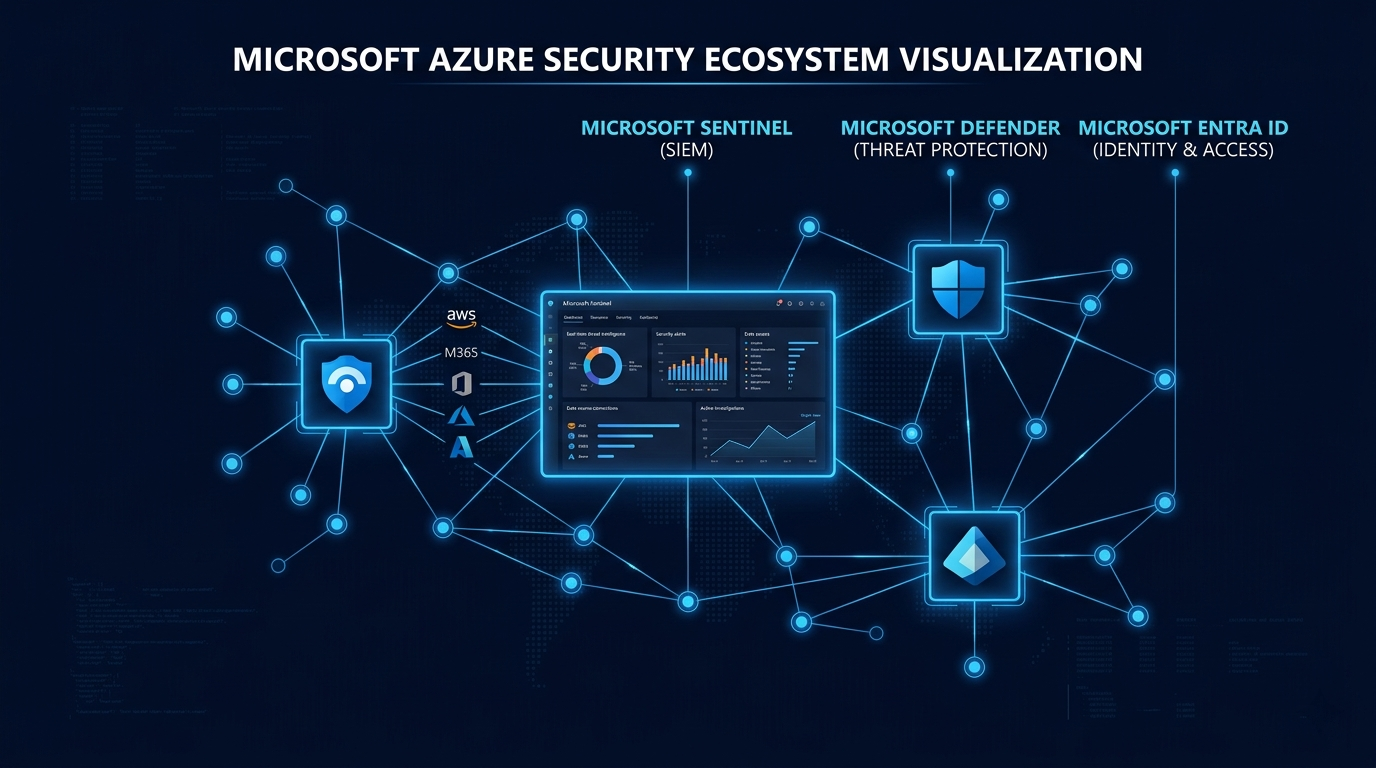
The Microsoft Security certification track is built around one reality: most enterprise SOCs, most government security teams, and most corporate IT environments run Microsoft tools. Azure Sentinel is one of the most widely deployed SIEM platforms in the world. Microsoft Defender is the default endpoint protection across millions of devices. Entra ID (formerly Azure Active Directory) controls identity for hundreds of millions of users. Microsoft describes their security mission clearly:
Microsoft’s security solutions help organizations protect, detect, and respond to threats across their entire digital estate — from endpoints and identities to cloud workloads and data. Our certifications validate the skills required to implement and operate these solutions at enterprise scale.
If you’re targeting SOC analyst, security engineer, or cloud security roles in enterprise environments — and especially if those environments run Microsoft infrastructure — this certification track is not optional. It’s expected.
Is This Right for You?
This is for you if...
- You’re targeting SOC analyst, security engineer, or cloud security roles in enterprise or government environments
- You work with or plan to work with Microsoft Sentinel, Defender, Entra ID, or Azure security services
- You want certifications that are recognized across the widest possible employer base globally
- You’re complementing a CompTIA Security+ or CySA+ with vendor-specific Microsoft depth
- You’re building toward a blue team or cloud security architecture career
- You need certifications that align with Microsoft’s role-based hiring framework
This is NOT for you if...
- You’re focused exclusively on offensive security — this is a defensive and cloud security track
- You work in environments that run no Microsoft infrastructure — check your target employer stack first
- You’re looking for vendor-neutral credentials — pair this with CompTIA, not replace it
- You haven’t built foundational security knowledge yet — start with CompTIA Security+ first
Certification Roadmap
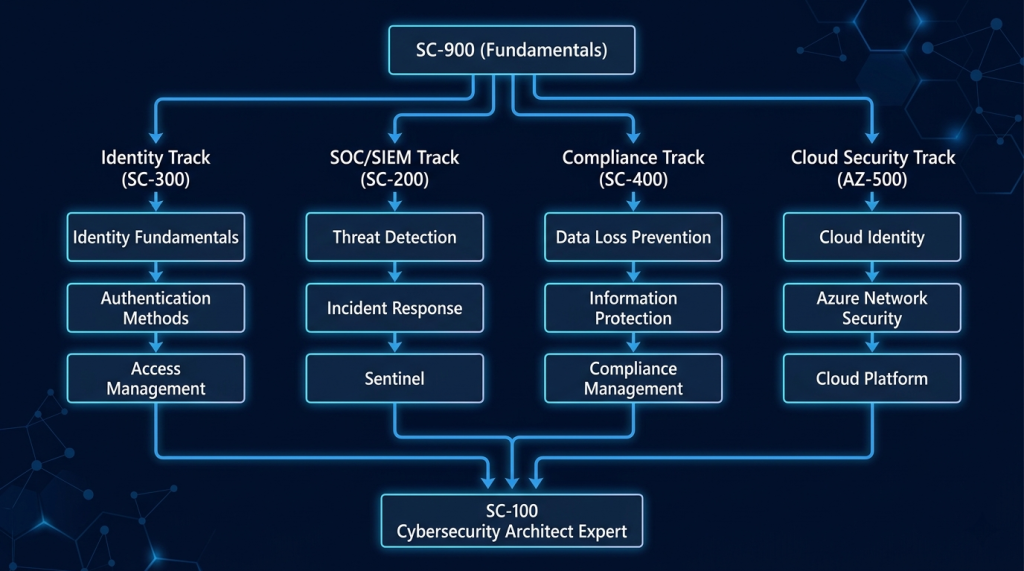
Microsoft’s security certifications are organized into a clear role-based hierarchy. Unlike vendor-neutral tracks, Microsoft certs map directly to specific job functions — making it straightforward to choose the right path based on the role you’re targeting.
Phase 1 — Foundation (0–2 Months)
SC-900 is Microsoft’s entry-level security certification. It covers the fundamentals of Microsoft security, compliance, and identity services — designed for non-technical stakeholders, career changers, and anyone who wants to understand the Microsoft security ecosystem before specializing. It’s the fastest Microsoft certification to obtain and the logical starting point.
| Certification | Exam Code | Focus | Questions | Exam Length | Passing Score |
|---|---|---|---|---|---|
|
Microsoft Security, Compliance, and Identity Fundamentals |
SC-900 |
Microsoft security concepts, cloud fundamentals, compliance, identity basics |
40–60 questions |
60 minutes |
700/1000 |
Phase 2 — Associate Level (2–8 Months)
After SC-900, you specialize based on your target role. Microsoft offers four distinct associate-level security certifications — each maps to a specific job function. Most practitioners pursue SC-200 first as it’s the most directly applicable to SOC analyst roles.
| Certification | Exam Code | Focus | Questions | Exam Length | Passing Score |
|---|---|---|---|---|---|
|
Microsoft Security Operations Analyst |
SC-200 |
Microsoft Sentinel, Defender XDR, threat detection, incident response, threat hunting |
40–60 questions |
120 minutes |
700/1000 |
|
Microsoft Identity and Access Administrator |
SC-300 |
Entra ID, Azure AD, SSO, MFA, conditional access, identity governance |
40–60 questions |
120 minutes |
700/1000 |
|
Microsoft Information Protection Administrator |
SC-400 |
Microsoft Purview, data classification, DLP, information protection, compliance |
40–60 questions |
120 minutes |
700/1000 |
|
Microsoft Azure Security Engineer |
AZ-500 |
Azure security services, network security, identity, data protection, security operations |
40–60 questions |
120 minutes |
700/1000 |
Which associate cert to pursue first depends on your role:
- SOC Analyst / Threat Hunter → SC-200 (Microsoft Sentinel and Defender XDR)
- Identity Engineer / Zero Trust → SC-300 (Entra ID and Access Management)
- Compliance / GRC Analyst → SC-400 (Microsoft Purview and Information Protection)
- Cloud Security Engineer → AZ-500 (Azure Security Engineering)
Phase 3 — Expert Level (8–18+ Months)
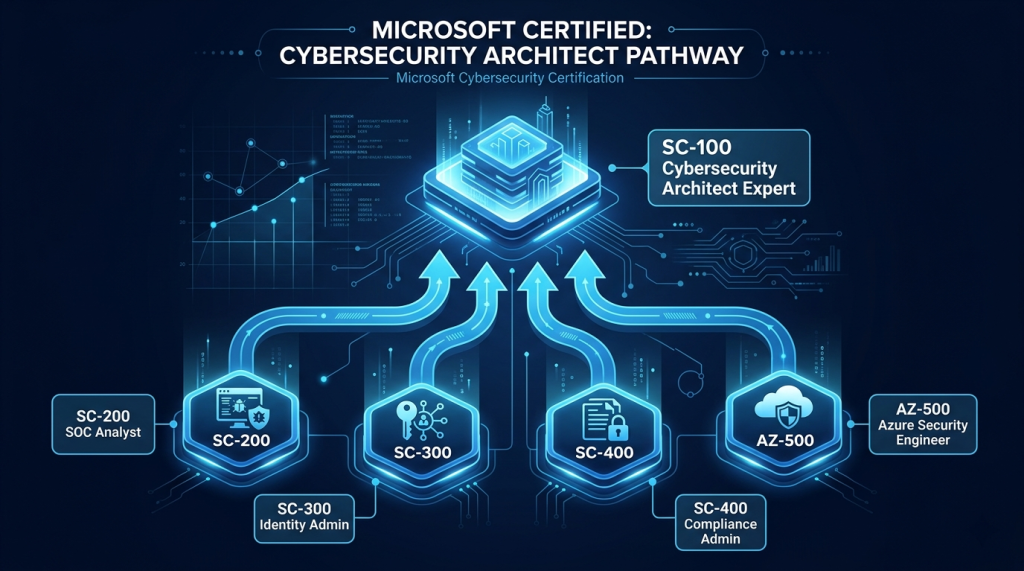
SC-100 is Microsoft’s highest security certification — the Cybersecurity Architect Expert credential. It requires passing at least one associate-level security exam before you can attempt it, and tests candidates on designing end-to-end security solutions across Microsoft’s entire platform. Microsoft positions it clearly:
The Microsoft Cybersecurity Architect has subject matter expertise in designing and evolving the cybersecurity strategy to protect an organization’s mission and business processes across all aspects of the enterprise architecture.
SC-100 is the cert that moves you from implementing security solutions to designing them at enterprise scale. It’s a significant step up in both difficulty and career impact.
| Certification | Exam Code | Prerequisites | Questions | Exam Length | Passing Score |
|---|---|---|---|---|---|
|
Microsoft Cybersecurity Architect Expert |
SC-100 |
At least one of: SC-200, SC-300, SC-400, AZ-500 required |
40–60 questions |
120 minutes |
700/1000 |
Microsoft Security Tools You'll Work With
Understanding the tools behind the certifications makes every exam and every job description easier to navigate. Here’s what each cert area actually means in practice:
| Tool / Service | What It Does | Related Cert |
|---|---|---|
|
Microsoft Sentinel |
Cloud-native SIEM and SOAR — collects, correlates, and responds to security events across the enterprise |
SC-200 |
|
Microsoft Defender XDR |
Extended Detection and Response — endpoint, identity, email, and cloud app protection unified in one console |
SC-200 |
|
Microsoft Defender for Cloud |
Cloud security posture management and workload protection for Azure, AWS, and GCP environments |
AZ-500 / SC-200 |
|
Microsoft Entra ID (Azure AD) |
Identity and access management — authentication, authorization, MFA, conditional access, privileged identity |
SC-300 |
|
Microsoft Purview |
Data governance, compliance, and information protection — classification, DLP, retention, eDiscovery |
SC-400 |
|
Azure Key Vault |
Secrets, keys, and certificate management for Azure workloads |
AZ-500 |
|
Microsoft Defender for Identity |
Detects identity-based threats using on-premises Active Directory signals |
SC-200 / SC-300 |
|
Microsoft Intune |
Endpoint management and mobile device management integrated with Defender |
SC-200 |
Career Opportunities
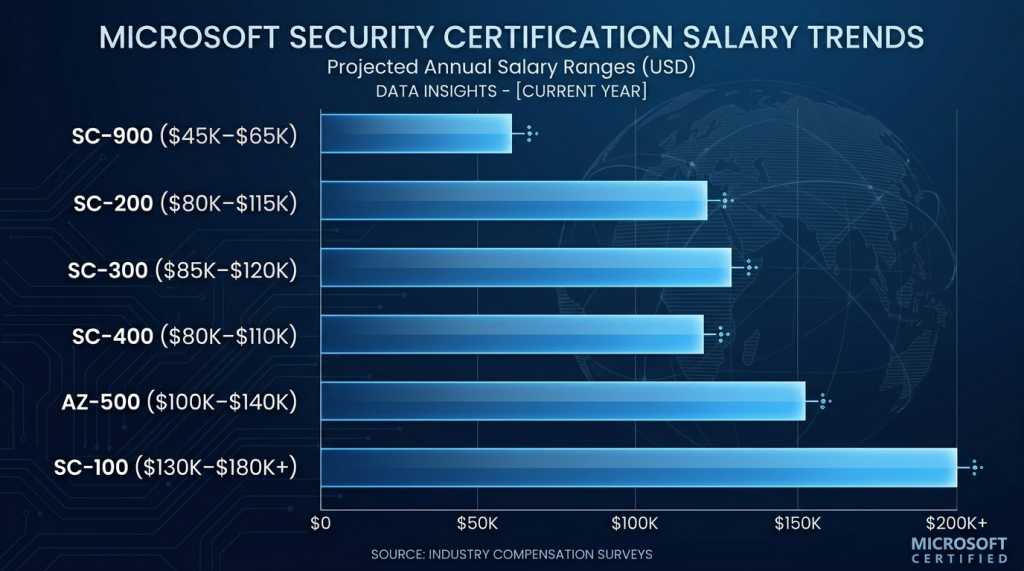
| Role | Target Job Titles | Average Salary (US) |
|---|---|---|
|
SC-900 |
IT Support, Junior Security Analyst, Compliance Coordinator |
$45,000 – $65,000 |
|
SC-200 |
SOC Analyst, Security Operations Engineer, Threat Hunter |
$80,000 – $115,000 |
|
SC-300 |
Identity Engineer, IAM Analyst, Zero Trust Architect |
$85,000 – $120,000 |
|
SC-400 |
Compliance Analyst, Information Protection Engineer, GRC Specialist |
$80,000 – $110,000 |
|
AZ-500 |
Azure Security Engineer, Cloud Security Engineer |
$100,000 – $140,000 |
|
SC-100 |
Cybersecurity Architect, Principal Security Engineer, CISO track |
$130,000 – $180,000+ |
Recommended Resources
Official Study Guides
Microsoft Learn is the official, free learning platform for all Microsoft certifications. Unlike many vendor training platforms, Microsoft Learn’s content is genuinely good — it covers every exam objective with hands-on sandboxes and knowledge checks:
Microsoft Learn provides free, self-paced learning paths aligned to every Microsoft certification exam. Our learn-by-doing approach includes interactive sandboxes, hands-on exercises, and practice assessments to prepare you for certification success.
- Microsoft Learn — free official learning paths for every Microsoft security cert
- Microsoft Security Documentation — product documentation for Sentinel, Defender, Entra ID
- Microsoft Defender XDR Ninja Training — free advanced training series from Microsoft’s own team
- Microsoft Sentinel Ninja Training — free advanced Sentinel training covering KQL, analytics rules, and SOAR
- SC-900 / SC-200 / AZ-500 official practice assessments — free on Microsoft Learn, mirrors exam style
- John Savill (YouTube) — the most respected free Microsoft certification study channel
- Thomas Maurer (YouTube/Blog) — Azure security and certification content
- Microsoft Security Community — active community for all Microsoft security products
Where to Practice
── Hands-On Practice Platforms ──
- Blue Team Labs Online — Splunk and SIEM scenarios that build directly transferable Sentinel skills
- LetsDefend — SOC analyst workflow simulation that mirrors real Sentinel alert investigation
- TryHackMe — SOC Level 1 and Blue Team paths for foundational defensive skills —
- ARMO CTRL — cloud-native security practice that complements AZ-500 cloud security skills
How to Get Started
- Start with SC-900 only if you’re new to Microsoft security. If you already hold Security+ or have 1+ years of IT experience, SC-900 may feel redundant. Experienced practitioners can skip straight to SC-200 or AZ-500. SC-900 is for absolute beginners to the Microsoft ecosystem.
- Choose SC-200 as your first associate cert unless your role specifically requires another. SC-200 is the most broadly applicable Microsoft security certification — SOC analysts, security engineers, and threat hunters all benefit from it. It also has the strongest alignment with Microsoft Sentinel, which is becoming the enterprise SIEM standard.
- Use Microsoft Learn daily, not as exam prep. The biggest mistake candidates make is treating Microsoft Learn as a cram resource. Use it daily — read the product documentation, complete the sandboxes, practice KQL queries in the free Sentinel workspace Microsoft provides. By exam day, the material should feel like tools you already use, not content you just reviewed.
📌 Note: The information on this page — including certification details, exam codes, pricing, and salary ranges — is regularly reviewed and updated to reflect the latest data from official sources. Always verify current details directly with the relevant certification body or platform before making any decisions.
Community & Support
── Microsoft Security Communities ──
Related Articles
The 6 Learning Paths Every Cybersecurity Beginner Should Know
Affiliate Disclaimer: Some links in this article are affiliate links. This means if you click a link and make a purchase, SecVerse may earn a small commission — at no extra cost to you. We only recommend tools we genuinely believe in and that we consider useful for your cybersecurity learning journey. Our editorial opinions are never influenced by affiliate relationships. Introduction: **In our first guide**, we covered how to start learning cybersecurity without feeling overwhelmed. If you haven’t read it yet, start there. Now, let’s talk about which path to take once you’re ready. When I decided to get into cybersecurity 20 years ago after I graduated from school of engineering as computer engineer, I had no idea which path to take. I bought a CEH course first. Then I bought a Security+ book. Then I tried to learn networking. I was all over the place. Don’t be me.
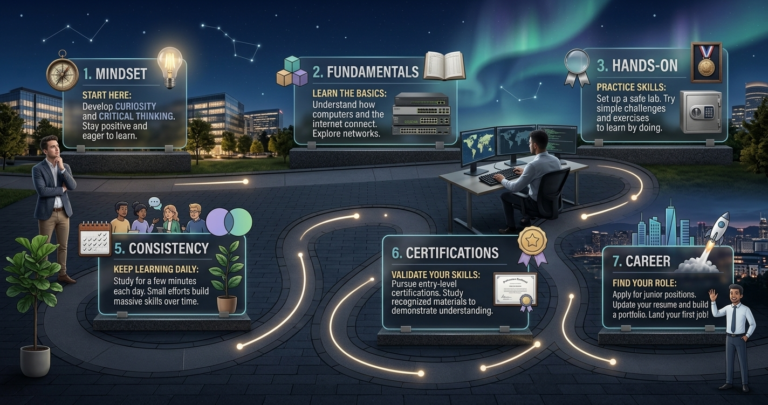
How to Start Learning Cybersecurity Without Feeling Overwhelmed
Affiliate Disclaimer: Some links in this article are affiliate links. This means if you click a link and make a purchase, SecVerse may earn a small commission — at no extra cost to you. We only recommend tools we genuinely believe in and that we consider useful for your cybersecurity learning journey. Our editorial opinions are never influenced by affiliate relationships. Introduction: The Overwhelm is Real (But Avoidable) Let’s be honest with ourselves to avoid the shock and be realistic. Cyber security is huge, branching, and massive field. When I decided to get and start in this field 20 years ago. I made every mistake imaginable: Bought expensive courses I never finished. Tried to learn everything at once – pentesting, malware analysis, cloud security, forensics. All in short time. Got trapped in “tutorial”- watching videos for hours but never actually doing anything because of not practicing them and being confused.