
Purple Team

Home > Resources > Learning Paths > Purple Team
FortiGate, FortiSIEM, FortiAnalyzer, FortiManager — One Unified Security Platform
Purple Team — Where Red and Blue Meet

What is Purple Teaming?

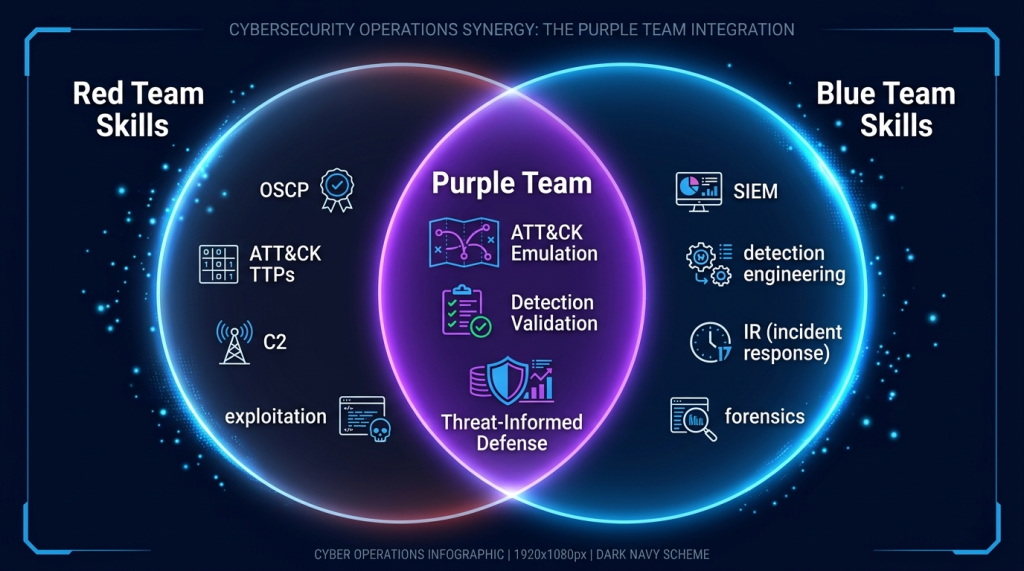
Purple Teaming is the collaborative integration of offensive (red team) and defensive (blue team) operations — working together simultaneously to test, validate, and improve security controls in real time. MITRE describes the philosophy:

Purple team exercises bring together offensive and defensive security professionals to collaboratively test and improve an organization’s detection and response capabilities, using a structured approach based on threat intelligence and the ATT&CK framework.

CISA has made purple team exercises a formal recommendation for critical infrastructure protection:

Purple team assessments help organizations validate that defensive controls are working as intended, identify gaps between what an organization thinks it can detect versus what it can actually detect, and provide actionable recommendations for improvement.

Where red teams find what you can’t defend, and blue teams build defenses, purple teams answer what neither can answer alone: are our defenses actually working against the specific attacks we face?

Is This Right for You?

This is for you if...

  • You have experience in either red team or blue team operations and want to bridge both
  • You want to run structured ATT&CK-based adversary emulation exercises with detection validation
  • You’re building or improving a security operations program at an organization with a mature SOC
  • You work in threat intelligence and want to operationalize TTPs against real defenses
  • You want to lead collaborative red/blue exercises rather than operate purely in one discipline

This is NOT for you if...

  • You have no red team or blue team experience — build one of those foundations first
  • You’re looking for a single certification path — purple teaming is a methodology, not primarily an exam track
  • Your organization has no SOC or detection capability — there’s nothing to purple team against yet

Certification Roadmap

NSE 1–3 (Free Foundation) → NSE 4 (Professional) → NSE 5–6 (Specialist) → NSE 7–8 (Expert
Purple Team Skill Intersection Diagram

Phase 1 — Foundation (Choose Your Side First)

Starting Point Recommended Path Why It Matters for Purple
Red Team Background
OSCP → CRTO → ATT&CK framework mastery
Understand how attacks execute to design exercises that test real TTPs
Blue Team Background
Security+ → CySA+ → GCIH → Detection Engineering
Understand what defenses exist to know what’s worth testing
Both simultaneously
BTL1 + TryHackMe offensive paths
Entry-level dual-track if completely new to security

Phase 2 — ATT&CK Framework Mastery (Essential)

Every purple team exercise is built on MITRE ATT&CK:

The ATT&CK framework provides the common language that makes purple teaming possible — a shared vocabulary that offensive and defensive teams can use to plan, execute, and debrief adversary emulation exercises.

  • Complete MITRE ATT&CK Defender (MAD) training — free, from MITRE Engenuity
  • Learn ATT&CK Navigator for exercise planning — free web tool
  • Study at least 3 real threat actor profiles from the ATT&CK Groups database
  • Practice mapping attack techniques to detection opportunities in your SIEM

Phase 3 — Purple Team Certifications

Certification Provider Focus Level
Certified Purple Team Professional (CPTP)
Cybrary
ATT&CK-based exercises, detection validation methodology
Intermediate
GDAT (Defending Advanced Threats)
SANS/GIAC
Threat-informed defense, detection engineering
Advanced
ATT&CK Threat Hunter
MITRE Engenuity
Threat hunting aligned to ATT&CK framework
Intermediate

Phase 4 — Purple Team Tooling

Tool Purpose Free?
MITRE ATT&CK Navigator
Exercise planning — map TTPs and coverage
Yes
Atomic Red Team
Execute ATT&CK-mapped test cases against your own defenses
Yes
CALDERA
Automated adversary emulation platform from MITRE
Yes
Vectr
Purple team exercise tracking and reporting platform
Free tier
Cobalt Strike / Havoc C2
Red team tooling for realistic attack simulation in exercises
Paid / Free
From Firewall Engineer at NSE 4 to Senior Security Architect at NSE 7–8
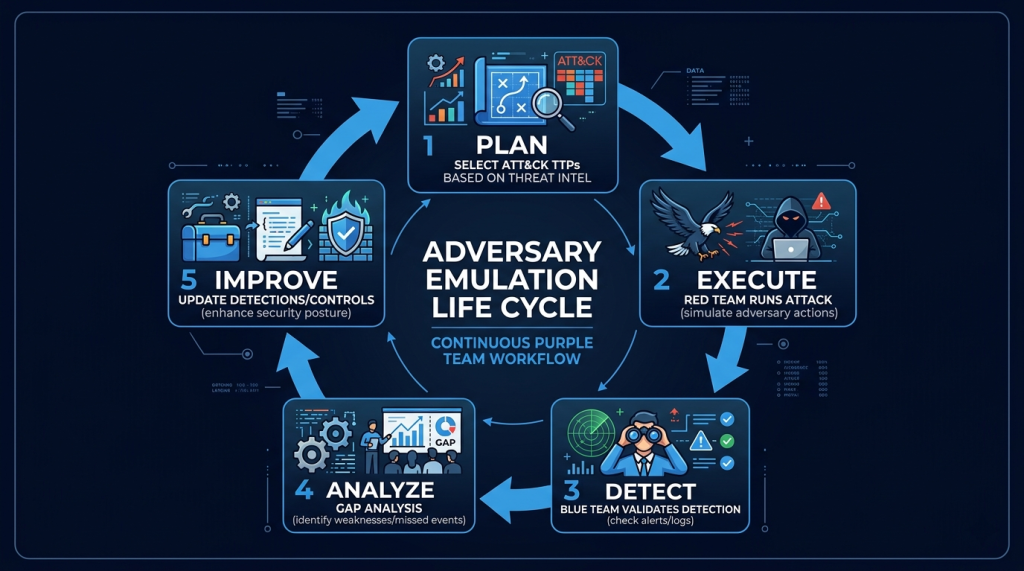
Purple Team Exercise Workflow

Career Opportunities

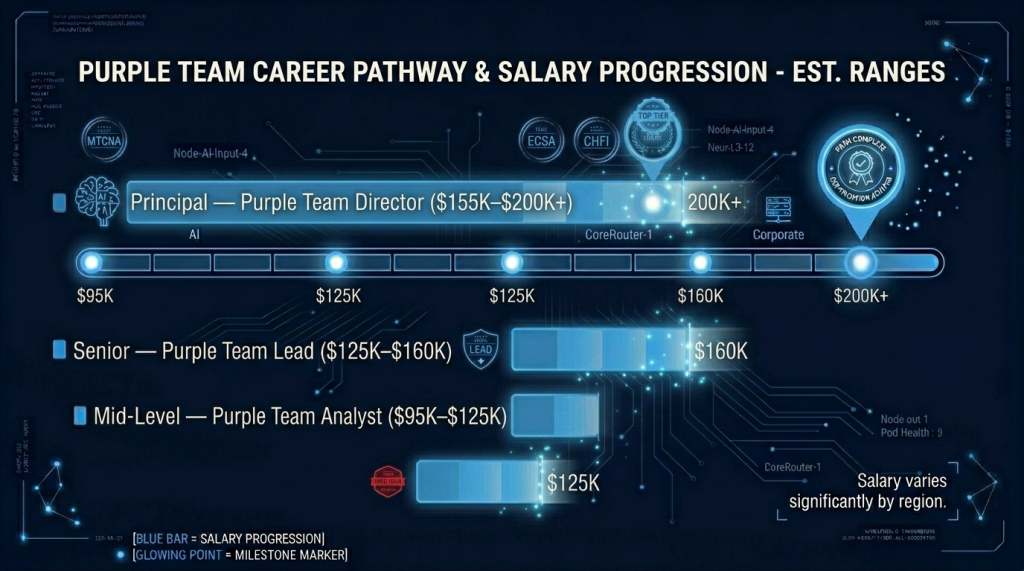
Role Target Job Titles Average Salary (US)
Mid-Level
Purple Team Analyst, Threat Emulation Analyst
$95,000 – $125,000
Senior
Purple Team Lead, Detection Engineering Lead
$125,000 – $160,000
Principal
Purple Team Director, Adversary Simulation Program Manager
$155,000 – $200,000+
Average US Salaries by Purple Team Career Level — Mid-Level Through Principal
Purple Team Salary Comparison Chart

Recommended Resources

Official Study Guides

  • MITRE ATT&CK — the foundation of every purple team exercise
  • MITRE D3FEND — defensive countermeasures mapped to ATT&CK
  • CISA Purple Teaming Guide — free official guidance from CISA
  • The Threat Hunter Playbook — open-source hunting knowledge base
  • Atomic Red Team — ATT&CK-mapped tests for immediate exercise use
  • Vectr — free purple team exercise management and reporting

Where to Practice

── Hands-On Practice Platforms ──

  • Hack The Box — offensive skill building and Pro Labs for adversary simulation 
  • Blue Team Labs Online — defensive scenario practice for detection validation 
  • TryHackMe — Adversary Emulation and Active Directory paths 
  • CyberWargames AI — adaptive APT-style scenarios for advanced purple team exercises 

How to Get Started

  1. Pick a side first and go deep. Don’t try to learn red and blue simultaneously from scratch. Pick the one that excites you more, get to intermediate level (OSCP or CySA+ equivalent), then cross-train deliberately.
  2. Run your first purple team exercise with Atomic Red Team. Install Atomic Red Team in a test environment. Pick one ATT&CK technique (start with T1059). Execute the test. Check whether your SIEM detects it. If not — write a detection rule. That’s a complete purple team exercise.
  3. Build a structured exercise program, not one-off tests. Use Vectr to track exercises, ATT&CK Navigator to visualize coverage, and run at least one structured exercise per month. The program compounds — each exercise makes the next one more targeted.

📌 Note: The information on this page — including certification details, exam codes, pricing, and salary ranges — is regularly reviewed and updated to reflect the latest data from official sources. Always verify current details directly with the relevant certification body or platform before making any decisions.

Community & Support

Related Articles

The 6 Learning Paths Every Cybersecurity Beginner Should Know

Affiliate Disclaimer: Some links in this article are affiliate links. This means if you click a link and make a purchase, SecVerse may earn a small commission — at no extra cost to you. We only recommend tools we genuinely believe in and that we consider useful for your cybersecurity learning journey. Our editorial opinions are never influenced by affiliate relationships. Introduction: **In our first guide**, we covered how to start learning cybersecurity without feeling overwhelmed. If you haven’t read it yet, start there. Now, let’s talk about which path to take once you’re ready. When I decided to get into cybersecurity 20 years ago after I graduated from school of engineering as computer engineer, I had no idea which path to take. I bought a CEH course first. Then I bought a Security+ book. Then I tried to learn networking. I was all over the place. Don’t be me.

Read More »

How to Start Learning Cybersecurity Without Feeling Overwhelmed

Affiliate Disclaimer: Some links in this article are affiliate links. This means if you click a link and make a purchase, SecVerse may earn a small commission — at no extra cost to you. We only recommend tools we genuinely believe in and that we consider useful for your cybersecurity learning journey. Our editorial opinions are never influenced by affiliate relationships. Introduction: The Overwhelm is Real (But Avoidable) Let’s be honest with ourselves to avoid the shock and be realistic. Cyber security is huge, branching, and massive field. When I decided to get and start in this field 20 years ago. I made every mistake imaginable: Bought expensive courses I never finished. Tried to learn everything at once – pentesting, malware analysis, cloud security, forensics. All in short time. Got trapped in “tutorial”- watching videos for hours but never actually doing anything because of not practicing them and being confused.
Read More »