PicoCTF

400+ Free Challenges Across Web Exploitation, Cryptography, Forensics, Reverse Engineering, and Binary Exploitation
picoCTF — Security Education Through Capture The Flag

What is picoCTF?

picoCTF is a free, educational Capture The Flag competition platform created by Carnegie Mellon University’s CyberSecurity Lab. CTF competitions present security challenges where participants find hidden ‘flags’ — strings proving they solved the challenge — by applying real security techniques. What makes picoCTF different is its educational design: every challenge category has built-in learning resources, difficulty scales gently from beginner to intermediate, and all challenges are available year-round in practice mode — the picoGym. 100% free, no paid tier, no paywalls.

Is This Right for You?

This is for you if...

  • You’re a student (high school or university) exploring cybersecurity for the first time
  • You learn better through puzzles and challenges than video courses or tutorials
  • You want 100% free access to a large, quality challenge library
  • You’re a teacher looking for classroom-appropriate security exercises
  • You want an introduction to CTF competition format before attempting harder platforms

This is NOT for you if...

  • You’re an experienced practitioner — most challenges will be too simple
  • You want real-world penetration testing practice — CTF challenges are stylized, not realistic
  • You need guided learning paths — picoCTF is challenge-based, not curriculum-based

Challenge Categories

Category What It Tests Beginner Entry Point Real-World Skill Built
General Skills
Linux commands, basic tooling, file manipulation
Obedient Cat
Command line proficiency, scripting basics
Web Exploitation
SQL injection, XSS, authentication bypass, source code review
Insp3ct0r
Web application security fundamentals
Cryptography
Caesar cipher, XOR, RSA basics, encoding vs encryption
The Numbers
Cryptographic thinking, encoding recognition
Reverse Engineering
Binary analysis, disassembly, compiled code understanding
Transformation
RE fundamentals — Ghidra, strings, ltrace
Forensics
File carving, steganography, metadata, PCAP analysis
Glory of the Garden
Digital forensics, Wireshark basics
Binary Exploitation
Buffer overflows, format strings, basic ROP
Stonks
Low-level exploitation, gdb debugging
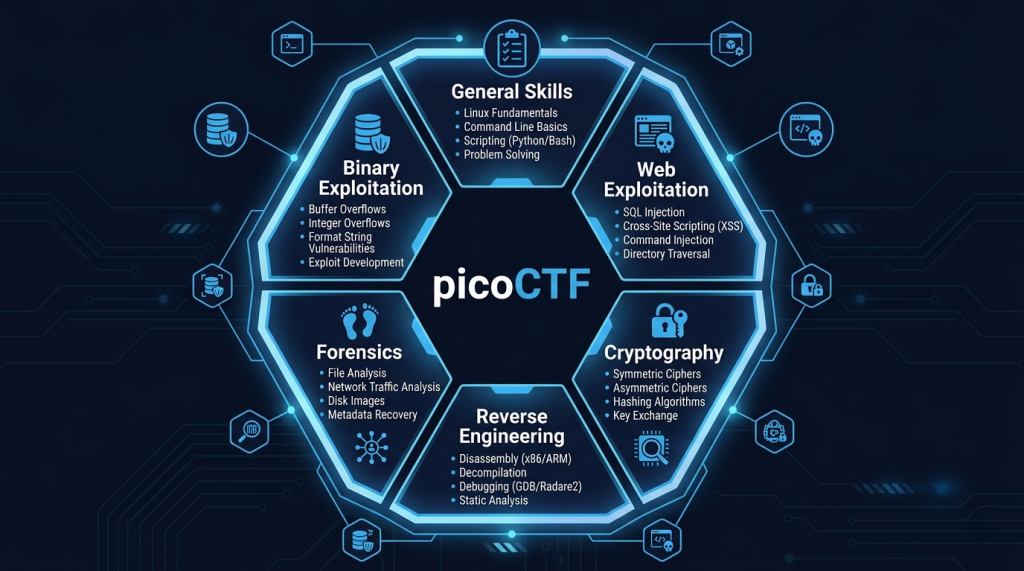
General Skills, Web Exploitation, Cryptography, Reverse Engineering, Forensics, Binary Exploitation
picoCTF Challenge Category Wheel

Platform Features

Feature Details
Annual Competition
Global CTF each spring — thousands of participants, prizes, rankings
picoGym (Practice Mode)
All previous competition challenges available year-round — 400+ challenges
Hint System
Built-in hints for every challenge — part of Carnegie Mellon’s educational design
Teacher Resources
Classroom guides, scoring dashboards, student account management
Pricing
100% FREE — no paid tier, no premium content, no paywalls
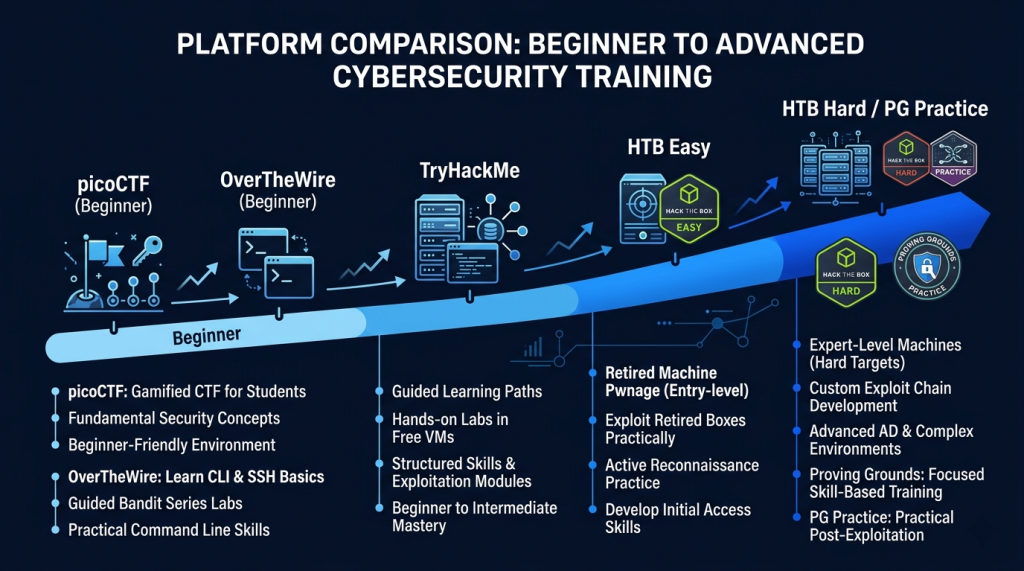
picoCTF and OverTheWire (Beginner) → TryHackMe (Intermediate) → HTB Easy → HTB Hard / PG Practice
Platform Progression Map — From picoCTF to HTB

Certification Prep — What picoCTF Helps With

Certification / Path picoCTF Categories That Help
CompTIA Security+
General Skills, Web Exploitation, Cryptography — builds conceptual understanding
CompTIA CySA+
Forensics, General Skills — log analysis and evidence interpretation thinking
CEH
Web Exploitation, Forensics — ethical hacking and investigation foundation
OSCP (early prep)
Web Exploitation, Binary Exploitation — methodology and tool familiarity
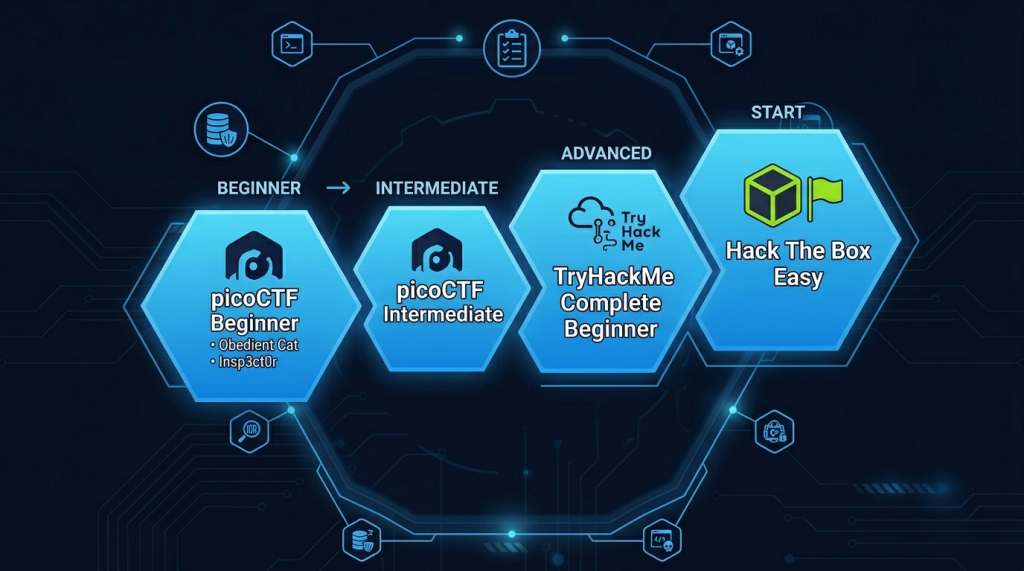
TryHackMe progression
picoCTF General Skills and Web prepare you for THM Complete Beginner path
400+ Challenges, 6 Categories, Year-Round Access, Zero Cost — The Student's Security Training Ground
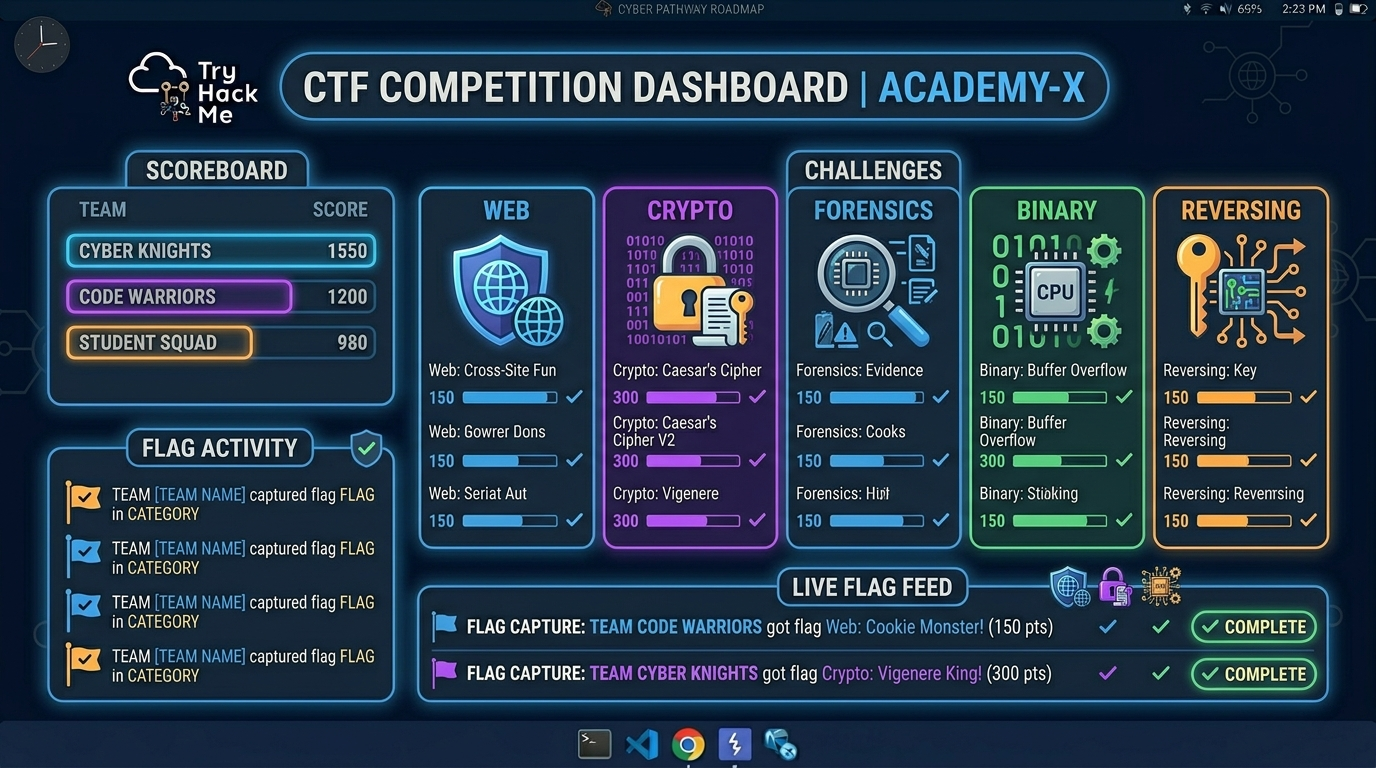
picoGym Challenge Library Overview

Recommended Resources

Official Study Guides

  • picoctf — account creation, competition registration, picoGym access
  • picoCTF Primer — official beginner guide to CTF concepts and tools
  • CTFtime — calendar of upcoming CTF competitions globally once you outgrow picoCTF
  • John Hammond (YouTube) — CTF walkthrough videos with methodology explanation
  • Cyberchef — essential free tool for cryptography and encoding challenges

── SecVerse Marketplace — Resources ──

Which Platform is Right for You?

picoCTF is the right choice when you are a complete beginner who learns through puzzles and challenges. Here is how it compares:

If you want... Best Choice
You want structured guided learning paths
TryHackMe — organized curricula with in-browser machines
You want pure Linux command line training via wargames
OverTheWire Bandit — the foundational Linux wargame
You want deep web security exercises with badges
PentesterLab — 200+ web vulnerability exercises
You want 100% free CTF challenges for beginners
picoCTF — this is the right choice

How to Get Started

  1. Create an account and go directly to picoGym. Don’t wait for the annual competition. Sort by difficulty (easiest first) and start with General Skills — Obedient Cat is literally the first challenge. It teaches you one command. That’s where everyone starts.
  2. Use the hint system — it’s part of the learning design. picoCTF’s hints are not cheating. When you’re stuck for more than 20 minutes, use a hint. Read what it tells you, figure out how it applies, then solve the challenge.
  3. After picoCTF, go to TryHackMe or OverTheWire. Once you can consistently solve Medium picoCTF challenges, you have the foundations to start TryHackMe’s Complete Beginner path. OverTheWire Bandit is another excellent next step for Linux skill building.

📌 Note: The information on this page — including certification details, exam codes, pricing, and salary ranges — is regularly reviewed and updated to reflect the latest data from official sources. Always verify current details directly with the relevant certification body or platform before making any decisions.

Community & Support

Related Articles

The 6 Learning Paths Every Cybersecurity Beginner Should Know

Affiliate Disclaimer: Some links in this article are affiliate links. This means if you click a link and make a purchase, SecVerse may earn a small commission — at no extra cost to you. We only recommend tools we genuinely believe in and that we consider useful for your cybersecurity learning journey. Our editorial opinions are never influenced by affiliate relationships. Introduction: **In our first guide**, we covered how to start learning cybersecurity without feeling overwhelmed. If you haven’t read it yet, start there. Now, let’s talk about which path to take once you’re ready. When I decided to get into cybersecurity 20 years ago after I graduated from school of engineering as computer engineer, I had no idea which path to take. I bought a CEH course first. Then I bought a Security+ book. Then I tried to learn networking. I was all over the place. Don’t be me.

Read More »

How to Start Learning Cybersecurity Without Feeling Overwhelmed

Affiliate Disclaimer: Some links in this article are affiliate links. This means if you click a link and make a purchase, SecVerse may earn a small commission — at no extra cost to you. We only recommend tools we genuinely believe in and that we consider useful for your cybersecurity learning journey. Our editorial opinions are never influenced by affiliate relationships. Introduction: The Overwhelm is Real (But Avoidable) Let’s be honest with ourselves to avoid the shock and be realistic. Cyber security is huge, branching, and massive field. When I decided to get and start in this field 20 years ago. I made every mistake imaginable: Bought expensive courses I never finished. Tried to learn everything at once – pentesting, malware analysis, cloud security, forensics. All in short time. Got trapped in “tutorial”- watching videos for hours but never actually doing anything because of not practicing them and being confused.
Read More »